Putin Confirmed for BRICS Summit 2026 as Over 30 Nations Wait for a Seat
Geopolitics · BRICS
Key Facts
- —The meeting The 18th BRICS summit is in New Delhi on 12–13 September at Bharat Mandapam.
- —The guests Putin’s attendance is confirmed; Xi and Pezeshkian are expected. Lula is skipping it to campaign at home.
- —The motto India’s motto is “Building for Resilience, Innovation, Cooperation and Sustainability”.
- —The queue Over 30 nations wait for a seat; New Delhi is expected to set the rules.
- —The catch BRICS may expand partner status, not full membership, to avoid fights.
Eight days before the summit, the honest answer is that nobody knows — including, perhaps, the ten governments at the table. What gets decided in New Delhi will say more about the bloc’s future than any communiqué drafted in advance.
Why this summit matters more than the last one
BRICS summits usually matter less for what they decide than for who shows up. This one is different, because three unresolved questions have piled up at once.
The bloc has grown from five founding members to ten full members in two expansion waves since 2024. Saudi Arabia was also invited in 2023, but it has never confirmed full membership, so it is not counted among the ten.
More than 30 countries have expressed interest in joining or partnering. India, which chairs this year, must either organise that queue or admit that the queue is the point.
The expansion question
The applicant list ranges from Serbia to Venezuela, and it is Venezuela that exposes the bloc’s internal politics. Brazil vetoed Venezuela’s bid at the 2024 Kazan summit, and India has signalled the same reluctance.
Brasília sees Venezuela’s bid as a sovereignty dispute brought into a trade-and-finance club.
New Delhi sees an unnecessary clash with Washington while India handles its own tariff talks with the U.S.
Given those disputes, BRICS is likely to widen the “partner country” tier instead of adding full members. That tier lets a country join without a veto over the others.
The bank, and the Iran problem
The New Development Bank (NDB), the bloc’s lender headquartered in Shanghai, is the most concrete thing BRICS has built. It is also where the Iran question has become unavoidable.
Iran’s central bank governor said in mid-August that the country would join soon. The bank told Reuters it could not confirm this, and the gap between those two statements is where the real negotiation sits.
Colombia shows the opposite problem. It agreed to join in 2025, but its Congress had still not passed the needed law by September 2026.
Money, minerals and the dollar
India’s central bank governor, Sanjay Malhotra, has pointed to India’s UPI payment system as a possible model for BRICS cross-border payments. Brazil has argued for de-dollarised trade since 2023, initially inside Mercosur, the South American trade bloc.
India actually runs a large trade deficit with its BRICS partners, not a surplus. The gap reached US$224 billion in 2025, most of it with China.
That imbalance is one reason New Delhi is wary of any currency plan that could favour China’s yuan.
For now, BRICS is more likely to expand small payment pilots and working groups than launch a shared currency. No member has agreed to one, and officials have floated the idea before without result.
The critical-minerals track is more concrete. BRICS members and partners, like South Africa, Egypt and Ethiopia, are building a joint strategy.
The strategy covers minerals used in batteries and chips, in response to Western export controls on the same materials.
What the declaration will actually tell you
Skip the preamble. Three paragraphs in the final declaration matter.
They are the sentence on expansion, the sentence on the bank’s membership, and any language on Ukraine or the Middle East.
All ten members could sign that language.
A short, vague declaration means the disagreements won. A long, specific one means India pulled off the hardest chairing job the bloc has yet attempted.
Who sits at the table
The guest list is half the message. Xi Jinping is widely expected to attend, which would be his first visit to India in seven years.
Putin’s attendance is confirmed by the Kremlin. India never signed the treaty that created the International Criminal Court, so it has no duty to act on the court’s warrant.
Pezeshkian’s expected appearance matters differently. Iran, a full member since 2024, wants bank membership and sanctions relief it cannot get elsewhere.
Lula will not attend. He is staying in Brazil to campaign ahead of the 4 October election, and Foreign Minister Mauro Vieira will represent Brazil instead.
The bilateral corridors at Bharat Mandapam will still carry more news than the plenary itself.
What the summit cannot fix
BRICS has no charter, no secretariat with power, and no enforcement. It decides by consensus, which means the slowest member sets the speed.
Its members also compete: India and China over influence, Brazil and its neighbours over regional leadership, everyone over export markets. The summit can align positions on paper; it cannot align interests.
The India-China subplot
Every BRICS summit is two summits: the public one, and the private handling of the bloc’s main rivalry.
India leads while trying to limit how much the group follows Chinese wishes; China knows it is the economy others cannot ignore.
The border disengagement of recent years lowered the temperature, not the competition. India-China trade hit a record US$155 billion in 2025, even as their strategic rivalry hardens.
What success looks like on 14 September
Three things are worth watching for when the summit ends. The first is written admission criteria for the expansion queue.
The second is clarity on the bank’s membership procedure. The third is a payment-pilot timeline specific enough to be checked next year.
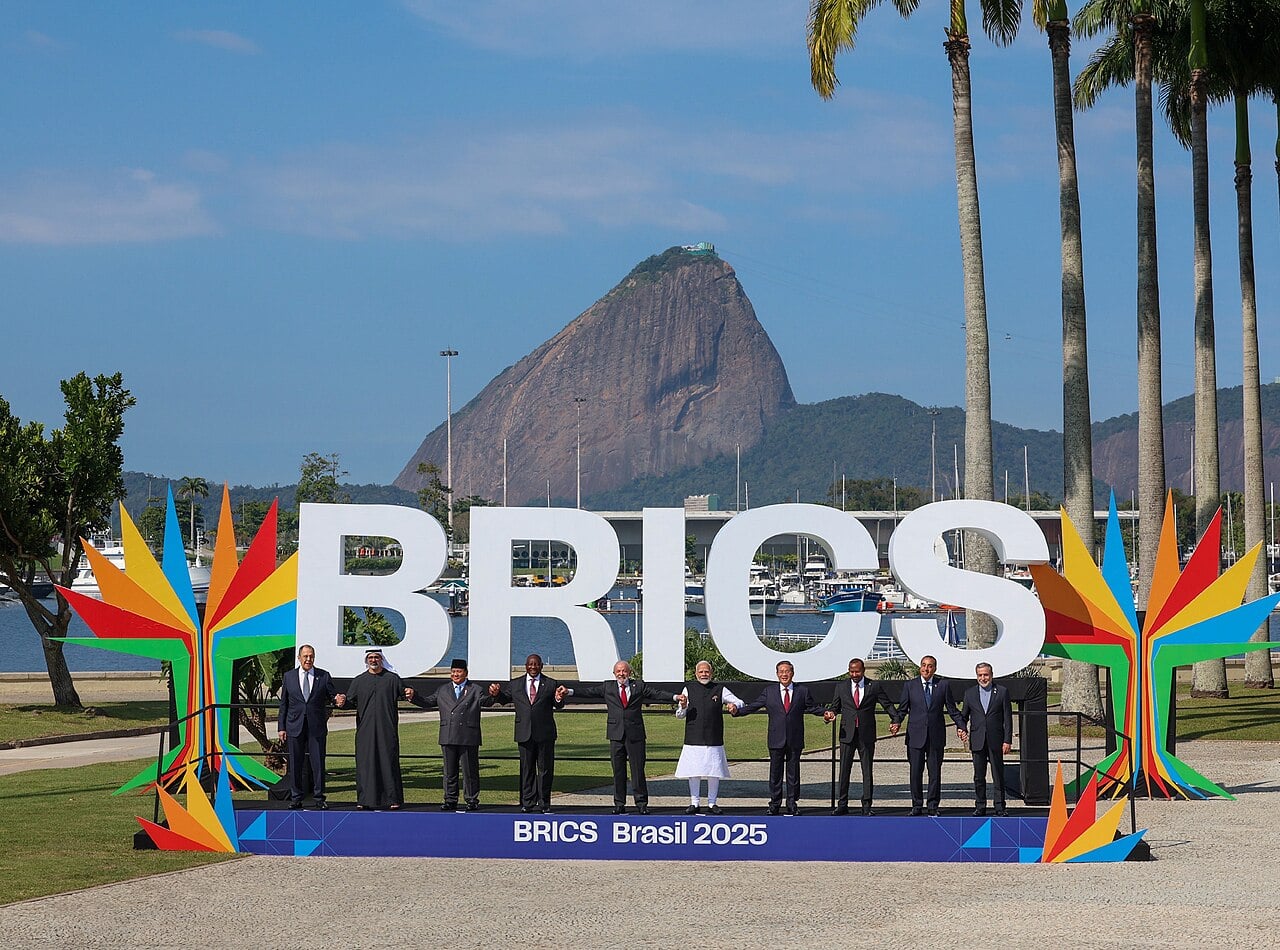
Anything less leaves the bloc where the Rio de Janeiro summit left it in 2025 — bigger, louder and undecided. Anything more would mark the moment BRICS started behaving like the institution its size implies.
The audience beyond the room
The summit lands about a week before the United Nations General Assembly’s high-level week opens in New York on 18 September. Whatever New Delhi agrees becomes the bloc’s opening position for the autumn’s diplomatic season.
Governments in Africa and Latin America that want to join will check the declaration for a date. More than thirty applicants are not just a number.
They are thirty bilateral relationships waiting for a sign.
More: Latin America news in English, every day from The Rio Times.
The bilateral calendar inside the summit
The plenary is theatre; the corridors are the event.
The Xi-Modi meeting, if it happens at leader level, is the bilateral that would draw the most attention.
Putin’s meetings matter for another reason: each is a step in his return to international travel after years of isolation.
Vieira’s bilaterals will focus on expansion and the bank file, the two priorities Brazil cares about most in the bloc.
The host’s own agenda is least examined but most consequential. India uses the chairmanship to position itself as the bloc’s swing power.
It is courted by Washington and useful to Beijing, and it is in no hurry to choose.
By 14 September, the summit will likely have produced a declaration, a family photograph and several corridor deals. Only the last of those reliably outlasts the news cycle.
Connected Coverage
30+ Nations Await a BRICS Seat — New Delhi Votes in September
Iran Says It Will Join the BRICS Bank — Bank Can’t Confirm
BRICS+ Builds Coordinated Critical-Mineral Strategy
The Big Picture
BRICS Expansion — all our coverage of the bloc’s growth and its limits
This article was produced by The Rio Times’ automated newsroom system. How we use AI · Report an error
Read More from The Rio Times