Fintechs and Digital Banks in Brazil 2026: Market Guide
Brazil: Fintech
Key Facts
—Nubank. The São Paulo-based digital bank serves 139 million customers across Brazil, Mexico, and Colombia (Q2 2026), including nearly 118 million in Brazil. It reported net income of US$2.9 billion for 2025 and a record US$1.1 billion in Q2 2026 alone, per its NYSE filings.
—Pix. Brazil’s instant-payment system processed 79.8 billion transactions in 2025, moving R$35.4 trillion (about US$6.8 trillion, at the August 31, 2026 rate of R$5.18 per dollar), and has run at roughly 6 billion transactions per month in early 2026, per the Central Bank (BCB). More than 170 million Brazilians — about 80% of the population — use Pix.
—Concentration. Brazil’s five largest banks (Itaú, Bradesco, Banco do Brasil, Caixa, Santander) still control roughly 80% of total banking assets, per BCB data. Fintechs have gained share in payments and consumer credit but not in commercial lending.
—Open Banking. Phase 4 of Brazil’s Open Banking framework, mandating payment initiation services, took effect in August 2025. As of June 2026, 148 institutions are registered as data transmitters, per BCB’s Open Finance registry.
—Credit. Total household credit in Brazil reached R$3.1 trillion (about US$600 billion) in June 2026, with delinquency rates (over 90 days) at 3.4% — down from 4.7% in 2023 but still above the 2019 pre-pandemic level of 2.8%.
Brazil’s fintech sector has produced Latin America’s most successful digital bank and the world’s most widely adopted instant-payment system — but the old banking oligopoly still controls the economy’s commanding heights.
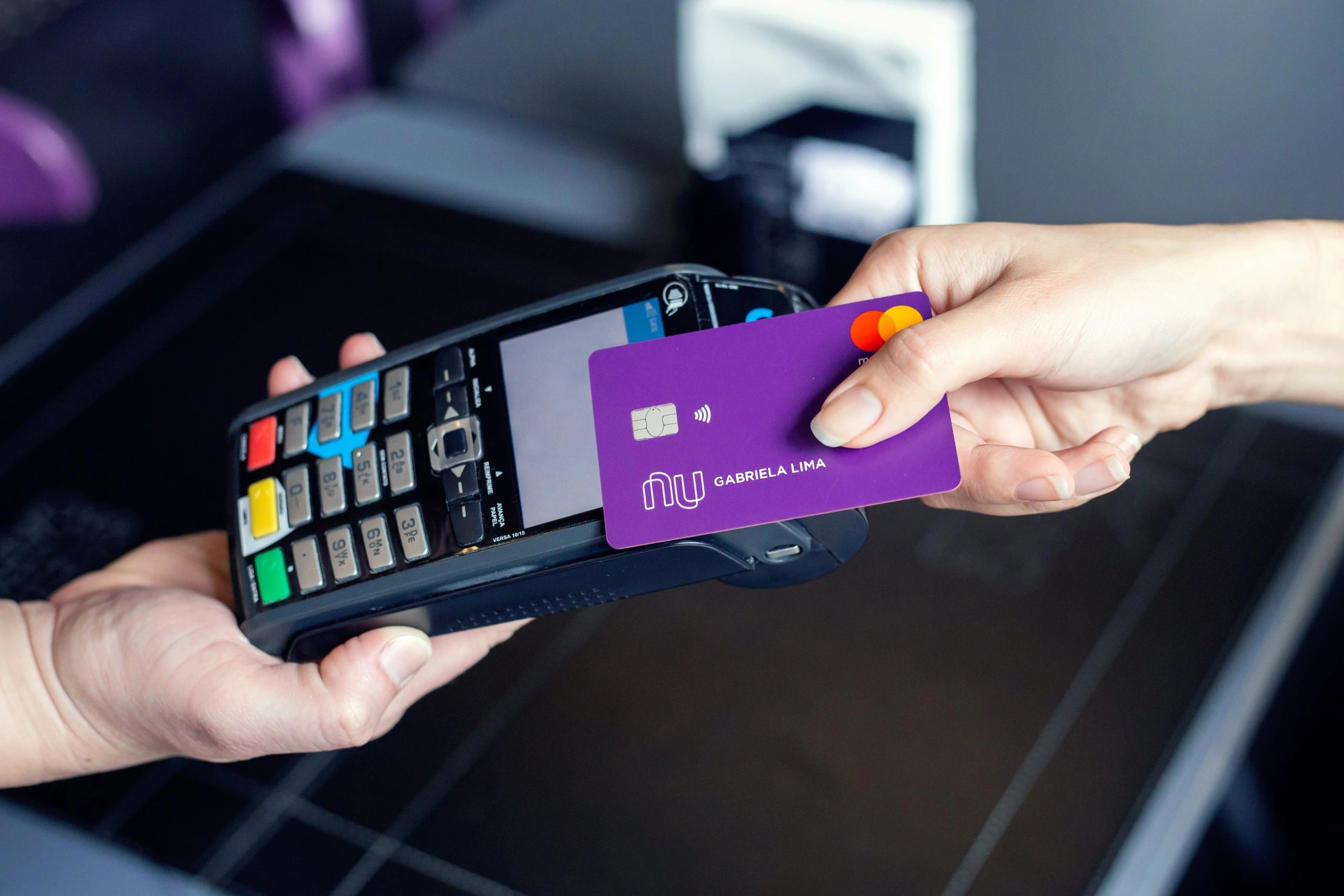
Nubank: The Benchmark and Its Limits
Nubank’s trajectory from a purple credit card startup in 2013 to a 139-million-customer digital bank listed on the NYSE is the defining story of Brazilian fintech. The company, founded by Colombian-born David Vélez with Brazilian partners Cristina Junqueira and Edward Wible, has been profitable since 2023 and reported net income of US$2.9 billion for 2025 — and a record US$1.1 billion in Q2 2026 alone, its first billion-dollar quarter. In August 2026 it launched its full bank in Mexico, where it already has 16 million customers, and is adding a full banking license to its Brazilian operation.
The business model is straightforward: acquire customers cheaply through digital marketing, cross-sell credit cards and personal loans, and monetize float on deposits. Nubank’s customer acquisition cost is estimated at US$5–8 per account, compared to US$30–50 for traditional banks opening branches. The key metric is engagement: Nubank reports a monthly activity rate of 83.5% — and over 86% in Brazil — a figure that drives cross-selling efficiency.
The limits are equally real. Nubank’s loan book is heavily concentrated in unsecured consumer credit — credit cards and personal loans. Its 90-day non-performing loan ratio was 6.9% in Q2 2026, up from 6.5% in the previous quarter and above the industry average — a level the company says reflects its deliberate expansion into riskier credit segments. The bank has been more cautious than some competitors in expanding into mortgage lending or small-business credit, segments that require more capital and longer-dated risk assessment.
Pix: The Public Infrastructure That Changed Everything
If Nubank is the headline, Pix is the infrastructure. Launched by the Central Bank in November 2020, Brazil’s instant-payment system allows real-time transfers between any registered account — bank, fintech, or payment institution — 24 hours a day, with no fees for individuals. The adoption curve has been steeper than any financial innovation in Brazilian history.
In 2025, Pix processed 79.8 billion transactions with a total value of R$35.4 trillion (about US$6.8 trillion), according to BCB data — growth of 26% in transaction count and 34% in value over 2024 — and the system has continued to run at roughly 6 billion transactions a month in early 2026. More than 170 million individuals, about 80% of Brazil’s population, are registered Pix users, and the system has largely displaced cash for small transactions in urban areas.
The impact on fintechs has been mixed. On one hand, Pix leveled the playing field: a customer of a small digital wallet can pay a Nubank user instantly, removing one of the traditional banks’ advantages in interbank transfers. On the other hand, Pix commoditized payments. Fintechs can no longer charge for P2P transfers, and merchant fees on Pix average a fraction of the 1.5–2.5% charged on credit card transactions. The winners are merchants and consumers; the losers are payment processors whose revenue depended on transfer fees.
The Oligopoly: Why Traditional Banks Still Win
Despite the fintech buzz, Brazil’s banking sector remains extraordinarily concentrated. The five largest institutions — Itaú Unibanco, Bradesco, Banco do Brasil, Caixa Econômica Federal, and Santander Brasil — still control roughly 80% of total banking assets, per BCB data. That concentration has declined only marginally in recent years, despite the fintech boom.
The reason is structural. Large corporates and high-net-worth individuals — the most profitable segments — still prefer traditional banks for complex lending, treasury services, and international operations. Itaú’s wholesale banking division alone generates tens of billions of reais in annual revenue. Mortgages, which represent the largest household liability class, are dominated by Caixa Econômica Federal, a state-owned bank that holds the majority of the housing finance market through the SFH system.
The traditional banks have also fought back digitally: Itaú, Bradesco, and Banco do Brasil each claim tens of millions of active app users. These are not startups experimenting with product-market fit — they are incumbent institutions with existing balance sheets, regulatory relationships, and corporate client networks that fintechs cannot easily replicate.
Open Banking and the Regulatory Shift
The Central Bank’s Open Banking initiative, launched in 2021 and rebranded as “Open Finance,” is the most consequential regulatory change in Brazilian retail banking since the Plano Real. The framework requires financial institutions to share customer data (with consent) and to allow third-party providers to initiate payments and offer credit products using bank infrastructure.
Phase 4, which mandated payment initiation services, took effect in August 2025. As of June 2026, 148 institutions are registered as data transmitters in the BCB’s Open Finance registry, including all major banks and most large fintechs. The practical effect is that a Nubank customer can now view their Bradesco account balance inside the Nubank app, and a small fintech can initiate a payment from a customer’s Itaú account without the customer leaving the fintech’s interface.
The long-term goal, according to the Central Bank, is to transform banking from a relationship-based model to a data-based model. The risk is data concentration: the largest fintechs, with the most users and the best algorithms, could end up with more customer insight than the banks themselves. Regulatory attention has already shifted to data privacy and algorithmic discrimination, with the National Data Protection Authority (ANPD) issuing guidelines in March 2026 that restrict how fintechs can use shared credit data.
Credit, Delinquency, and the Consumer Debt Cycle
Brazil’s household credit market is both large and expensive. Total outstanding credit reached R$3.1 trillion (about US$600 billion) in June 2026, equivalent to roughly 48% of GDP. The average interest rate on non-directed consumer credit was 32.6% per year in July 2026, according to BCB’s monthly credit survey. Directed credit — subsidized mortgages and agribusiness loans — carries lower rates (8–10%) but is restricted to specific purposes and borrower profiles.
Fintechs have expanded access to credit for borrowers previously excluded by traditional banks’ risk models. The trade-off is price: fintech personal loans typically charge 4–8% per month (60–150% annualized), well above bank rates. The justification is that fintechs serve a riskier population — gig workers, informal entrepreneurs, and young adults without credit history — that traditional banks refuse to lend to at any price.
Delinquency rates have stabilized but remain elevated. The 90-day non-performing loan ratio was 3.4% in June 2026, down from a post-pandemic peak of 4.7% in 2023 but above the 2.8% recorded in 2019. Fintech portfolios show higher delinquency than traditional banks: Nu Holdings reported a 6.9% 90-day NPL ratio in Q2 2026, and Inter and C6 Bank have also run above-industry-average delinquency, per their disclosures. Whether these rates are sustainable depends on Brazil’s employment trajectory and the Central Bank’s monetary policy cycle. With the Selic rate at 14.0% in August 2026 — after four consecutive cuts from the 15% peak reached in 2025 — borrowing costs are easing, but they remain high by international standards.
What Comes Next for Brazil’s Fintech Market
For a foreign reader, Brazil’s fintech landscape offers two lessons. First, regulatory infrastructure matters more than startup culture: Pix succeeded because the Central Bank mandated interoperability and subsidized the infrastructure. Second, market share in payments does not translate automatically to profitability in lending: Nubank’s path to profit required years of scale-building and careful risk selection.
The next phase of competition will focus on three areas: small-business banking, where fintechs like Stone and Mercado Pago are challenging Itaú and Bradesco; wealth management, where digital brokers such as XP and Avenue are democratizing access to US equities; and embedded finance, where non-financial platforms (delivery apps, ride-hailing, e-commerce) are integrating lending and insurance into their core products.
The oligopoly is not dead — Itaú and Bradesco will remain dominant in corporate and high-net-worth banking for years. But the retail battlefield has shifted. The Brazilian consumer now expects free instant payments, a fully digital account opening process, and credit decisions in minutes rather than days. That expectation, more than any single company’s market share, is the lasting legacy of the fintech wave.
Background: Brazil Tax Reform Timeline: Tech Sector Faces 2026 Invoice Shock.
Background: Fintechs and Digital Banks in Brazil 2026: Market Guide.
Background: Brazil Inflation Rate 2026: IPCA, Selic and What’s Next.
Frequently Asked Questions
What is Pix and how does it work?
Pix is Brazil’s instant-payment system operated by the Central Bank. It allows real-time, fee-free transfers between any registered accounts 24/7 using a phone number, email, or QR code. It processed 79.8 billion transactions in 2025 and roughly 6 billion per month in early 2026.
Is Nubank profitable?
Yes. Nubank has been profitable since 2023, reported net income of US$2.9 billion for 2025, and earned a record US$1.1 billion in Q2 2026. It serves 139 million customers across Brazil, Mexico, and Colombia.
Do traditional Brazilian banks still dominate?
Yes. The five largest banks (Itaú, Bradesco, Banco do Brasil, Caixa, Santander) control roughly 80% of total banking assets. Fintechs have gained ground in payments and consumer credit but not in commercial lending or mortgages.
Connected Coverage
Brazil’s financial sector continues to reshape how Latin America banks and pays.
Sources: Banco Central do Brasil; Nubank Investor Relations; Itaú Unibanco; Banco Bradesco; ANPD.
This article was produced by The Rio Times’ automated newsroom system. How we use AI · Report an error
Read More from The Rio Times