Gold Falls to US$4,033, Silver to US$56.90 as War Premium Drains
Key Facts
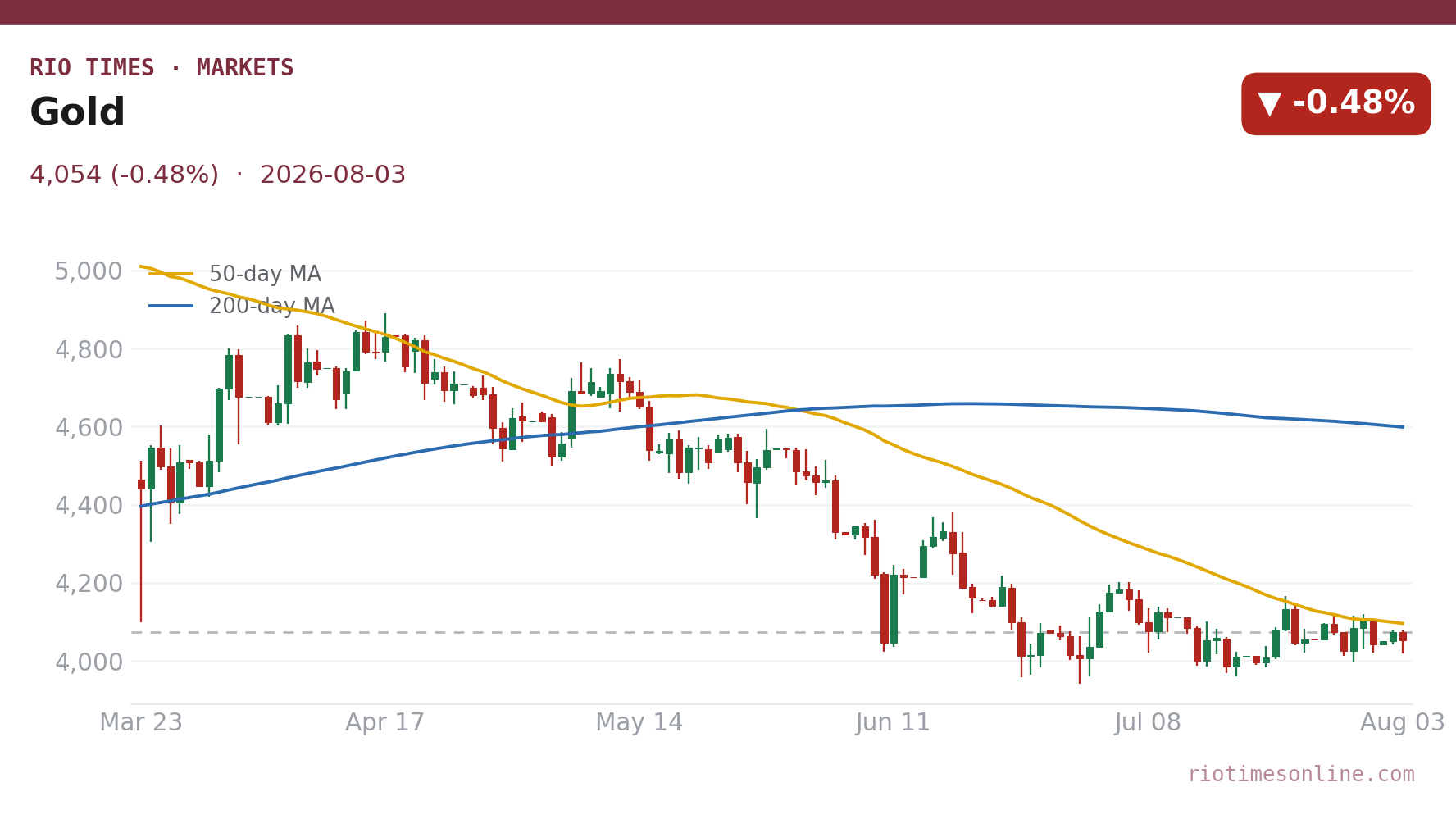
- Spot gold settled at US$4,032.89 an ounce, down US$9.24 or 0.23%, as the Middle East risk premium drained out of bullion.
- Spot silver closed at US$56.90 an ounce, down US$0.69 or 1.20% — more than five times the percentage fall in gold.
- The gold/silver ratio widened to 70.88, its broadest reading in more than a week, as silver gave back the larger share of its war premium.
- Crude collapsed after President Trump held off a planned strike on Iran, with Brent settling at US$83.86 a barrel, down 4.63%, and September WTI at US$79.94, down 5.59%.
- The US Dollar Index fell to a seven-week low of 99.42 after a coordinated US-Japan intervention lifted the yen — a tailwind for metals that the de-escalation overwhelmed.
- Mexico is the world’s largest silver producer and Peru a top-three producer, so Fresnillo, Grupo México, Buenaventura and Hochschild Mining carry leveraged exposure to silver’s slide.
Today’s Focus
Gold fell 0.23% to US$4,032.89 an ounce and silver dropped 1.20% to US$56.90 on Monday, giving back part of the safe-haven premium built up through July. The SPDR Gold Trust (GLD) closed at US$371.71 and the iShares Silver Trust (SLV) at US$52.46.
The driver was de-escalation, not the dollar. Over the weekend President Trump held off a planned strike on Iran, saying the outline of a deal had been agreed that would open the Strait of Hormuz and end Tehran’s nuclear threat. Crude collapsed on the news — Brent settled at US$83.86 a barrel, down 4.63%, and September WTI at US$79.94, down 5.59% — and the war premium that had propped up bullion for weeks drained away with it. Latin American oil producers were marked down in the same session.
The dollar did soften. A coordinated intervention by the US Treasury and Japan’s Ministry of Finance to support the yen pushed the US Dollar Index to a seven-week low of 99.42 and the dollar to roughly 156 yen, from just above 163 last week. That is normally a tailwind for dollar-priced metals. On Monday it was not enough.
For Latin America the session cut both ways. Lower metal prices trim the dollar revenue of Mexican and Peruvian producers, while a softer dollar lifts the peso and the sol and therefore raises the dollar cost of local wages, power and diesel.
What matters today. The precious-metals complex fell because a de-escalation headline removed the war premium — not because the dollar strengthened. The dollar in fact hit a seven-week low, and gold and silver still finished lower.
01 The session in one read
Gold fell 0.23% to US$4,032.89 an ounce and silver 1.20% to US$56.90, with both metals surrendering part of the risk premium accumulated during July’s escalation over Iran. The US-listed physically backed trackers closed at US$371.71 for the SPDR Gold Trust (GLD), US$76.19 for the iShares Gold Trust (IAU), US$52.46 for the iShares Silver Trust (SLV) and US$55.13 for the Aberdeen Standard Physical Silver Shares ETF (SIVR).
Silver did the heavy lifting on the downside. Its 1.20% fall, against a 0.23% decline in gold, pushed the gold/silver ratio out to 70.88, the widest in more than a week. That is the signature of a risk-premium unwind rather than an industrial-demand story: silver carries the larger speculative position and the higher beta in both directions.
The tempting read on Monday was that a weaker dollar should have lifted bullion. It did not, and the reason is the transmission chain that has governed this market all summer. Iran-driven oil spikes fed inflation fears, which forced traders to price Federal Reserve rate hikes, which lifted the dollar and real yields — the actual weight on gold. When President Trump stood the strike down and crude fell more than US$4 a barrel, that chain went into reverse: the inflation impulse faded and the rate-hike odds that had run near 81% before the Fed’s late-July meeting began to retreat. The first-order effect was a lower gold price as the war premium left the tape; the second-order effect, a lower path for policy rates, works in bullion’s favour but takes longer to show up. The variable to watch is whether the Strait of Hormuz talks hold. If they stall, the premium comes straight back.
02 The board
The four physically backed trackers closed at US$371.71 (GLD), US$76.19 (IAU), US$52.46 (SLV) and US$55.13 (SIVR). Those closing levels are consistent with spot gold at US$4,032.89 and spot silver at US$56.90, and they are the reference points used throughout this report.
A note on the data. The vendor feed that supplied Monday’s prices also carried percentage-change fields showing small gains for all four trackers — 0.05% for GLD, 0.19% for SLV, 0.03% for IAU and 0.15% for SIVR — alongside spot moves of plus 0.27% for gold and plus 0.81% for silver. The two sets cannot be reconciled: a physically backed tracker cannot move a quarter as far as the metal it holds in a single session. The spot percentages were wrong, and the tracker percentage fields could not be verified against an independent source either. We have therefore withdrawn all four tracker percentage figures and report only their closing levels, alongside the verified spot moves below.
| Asset | Level | Change |
|---|---|---|
| Gold (spot) | US$4,032.89/oz | -0.23% |
| Silver (spot) | US$56.90/oz | -1.20% |
| Brent crude | US$83.86/bbl | -4.63% |
| WTI (September) | US$79.94/bbl | -5.59% |
| Gold/silver ratio | 70.88 | Widest in over a week |
| US Dollar Index | 99.42 | Seven-week low |
Sources: verified spot close for 2026-08-03; Brent, WTI and the US Dollar Index from same-day market reports. Tracker closing levels from RT, 2026-08-03. Percentage-change fields carried in the original feed have been withdrawn where they could not be independently verified.
Live Market IntelligenceThe live market board
Rio Times · Live Market Intelligence
Latin America — Cross-Market Board
| Instrument | Last | Change | YoY | Prev. | High | Low | Volume |
|---|---|---|---|---|---|---|---|
| IBOV | 167,874.64 | -2.50% | +24.22% | 172,179.93 | 172,386 | 168,470 | — |
| IPSA | 11,128.56 | -1.25% | — | 11,268.86 | 11,308 | 11,084 | 1,513,213,483 |
| IPC MEX | 66,438.58 | -0.75% | +12.70% | 66,938.64 | 66,459 | 65,637 | 28,754,163 |
| MERVAL | 3,022,485 | -3.19% | +32.12% | 3,122,065 | 3,185,663 | 3,041,807 | — |
| COLCAP | 2,423.37 | +2.14% | — | 9.04 | 9.05 | 9.02 | 4,133 |
| BVL PERÚ | 59,693.55 | -1.60% | — | — | — | — | — |
| USD/BRL | 5.16 | +1.01% | -5.00% | 5.11 | 5.17 | 5.10 | — |
| EUR/BRL | 5.95 | +1.45% | -5.81% | 5.87 | 5.96 | 5.89 | — |
| USD/MXN | 17.10 | -0.22% | -7.96% | 17.14 | 17.16 | 17.10 | — |
| USD/CLP | 913.58 | -0.40% | -5.60% | 917.27 | 916.37 | 912.70 | — |
| USD/COP | 3,116 | -1.26% | -22.91% | 3,156 | 3,144 | 3,104 | — |
| USD/PEN | 3.38 | -0.09% | -2.62% | 3.38 | 3.38 | 3.36 | — |
| USD/ARS | 1,493 | -0.39% | +12.66% | 1,498 | 1,498 | 1,490 | — |
| USD/UYU | 40.23 | +1.56% | +1.70% | 39.61 | 40.25 | 40.23 | — |
| USD/PYG | 5,925 | +1.88% | -19.59% | 5,816 | 5,925 | 5,922 | — |
| USD/BOB | 11.72 | +0.37% | +74.16% | 11.68 | 11.80 | 11.72 | — |
| USD/DOP | 58.20 | +1.20% | -3.49% | 57.51 | 58.20 | 58.05 | — |
| USD/CRC | 447.79 | +1.51% | -9.36% | 441.12 | 447.88 | 446.85 | — |
03 What moved it
De-escalation was the proximate cause. President Trump said early on Sunday that Iran and other Middle Eastern countries had asked him to hold off any attack because the outline of a deal had been agreed — one that would open the Strait of Hormuz and end Iran’s nuclear threat. Iran’s foreign ministry said on Monday that while there were no direct negotiations with Washington, talks with Oman on management of the strait were in their final stages. Bullion had been carrying a war premium against exactly that tail risk, and it came out of the price quickly.
Oil did the rest of the work. The 4.63% slide in Brent to US$83.86 and the 5.59% drop in September WTI to US$79.94 cool the inflation impulse that drove Federal Reserve rate-hike pricing through the summer. UBS commodity analyst Giovanni Staunovo told CNBC that the lower oil price reduces US rate-hike expectations for this year and, in turn, supports gold — a reminder that Monday’s decline and the medium-term case for bullion are not the same trade.
Silver fell harder for structural reasons. It is the smaller, thinner market, it had absorbed more speculative haven money during July, and its industrial leg offers no protection when the driver is a geopolitical unwind rather than a manufacturing signal.
04 The Latin American read
Mexico is the world’s largest silver producer and Peru a top-three silver miner and major gold supplier, so a 1.20% fall in silver reads straight through to regional revenue. Producers sell in US dollars, and every dollar off the metal price lands on the top line.
The dollar leg is the part most often stated backwards. Mexican and Peruvian miners pay wages, power and diesel in pesos and soles but sell in US dollars, so a weaker dollar — which is what Monday delivered, with the US Dollar Index at a seven-week low of 99.42 — lifts those local currencies and therefore raises the dollar cost of production. Monday was a squeeze from both ends: less dollar revenue per ounce and a higher dollar cost base. Our Mexico markets report for the same session shows the peso firming as the S&P/BMV IPC slipped.
That pressure is cyclical rather than structural. Fresnillo profit tripled to US$1.46 billion on the gold and silver rally, a reminder of how much operating leverage these names carry when the metal price is running the other way. Fresnillo plc runs its flagship mines in Zacatecas and Durango; Buenaventura and Hochschild Mining work the same way in reverse in the Andes, which is why they trade as leveraged proxies for the spot price rather than as ordinary industrials — the pattern also visible in the swings at Buenaventura and Nexa across the Peruvian zinc complex.
05 The names to watch
The SPDR Gold Trust (GLD, at US$371.71) and the iShares Silver Trust (SLV, at US$52.46) remain the most liquid listed ways to track the two metals. The iShares Gold Trust (IAU, at US$76.19) and Aberdeen Standard Physical Silver Shares (SIVR, at US$55.13) hold near-identical underlying pools at lower cost.
Among Latin American producers, Fresnillo and Grupo México dominate Mexico’s silver landscape, while Buenaventura and Hochschild Mining are Peru’s most widely followed precious-metals names. All four show higher beta to the underlying metal than the physically backed trackers, which amplifies down days exactly as reliably as it amplifies up days.
06 The outlook
The near-term direction hinges on the Strait of Hormuz, not on the dollar. If the Oman-brokered arrangement holds and crude keeps sliding, the war premium stays out of bullion and gold’s support has to come from the slower channel: falling rate-hike odds, a softer dollar and continued official-sector buying, which ran to 289 tonnes of central-bank purchases in the second quarter. If the talks stall, the premium returns as fast as it left.
That is close to what followed. Gold and silver rebounded on Tuesday, and by Thursday gold had jumped to US$4,278 with silver back above US$62 — a round trip that underlines how thin the peace premium proved to be. Readers comparing sessions can also revisit the preceding precious-metals wrap.
07 What to watch
- The Hormuz talks: Iran and Oman say discussions on managing the strait are in their final stages. A breakdown would put the war premium straight back into gold and silver.
- Crude: Brent at US$83.86 after a 4.63% fall is the best live read on how much geopolitical risk is still priced. Further declines pressure bullion in the short run while easing rate-hike odds in the medium run.
- The dollar and intervention follow-through: Washington and Tokyo have signalled readiness to intervene again. A US Dollar Index sustained below 99.42 should eventually assert itself in the metal price once the risk unwind is complete.
- The gold/silver ratio at 70.88: A ratio that keeps widening says the market is still unwinding silver’s haven length; compression back below 69 would signal the industrial bid taking over.
Frequently Asked Questions
Why did gold and silver fall on Monday, 3 August 2026?
The war premium drained out of bullion. President Trump held off a planned strike on Iran and set out the outline of a deal to open the Strait of Hormuz, so crude collapsed and the safe-haven bid unwound. Spot gold fell 0.23% to US$4,032.89 an ounce and spot silver fell 1.20% to US$56.90.
Why did silver fall further than gold?
Silver had absorbed more of the speculative haven money built up during the July escalation over Iran, and it is the thinner, higher-beta market, so it gave back more when the risk headline reversed. Its 1.20% slide, against a 0.23% fall in gold, widened the gold/silver ratio to 70.88, the broadest reading in more than a week.
The dollar hit a seven-week low. Why did that not lift gold?
It helped, but it was overwhelmed. A coordinated US-Japan intervention to support the yen pushed the US Dollar Index to 99.42 and the dollar to about 156 yen, from just above 163. A softer dollar normally lifts dollar-priced metals, but the collapse in crude and the fading Middle East risk premium dominated the session.
What does a lower silver price mean for Mexican and Peruvian miners?
It squeezes them from both sides. Fresnillo and Grupo México in Mexico, and Buenaventura and Hochschild Mining in Peru, sell output in US dollars but pay wages, power and diesel in pesos and soles. A weaker metal price cuts dollar revenue, while a softer dollar lifts those local currencies and raises the dollar cost of production.
Sources: USAGOLD daily precious metals market report, 3 August 2026; CNBC on gold and the Iran pause; CNBC on Brent, WTI and the Hormuz deal; CNBC on the coordinated US-Japan yen intervention; Bloomberg via The Spokesman-Review on the Hormuz talks.
This article was produced by The Rio Times’ automated newsroom system. How we use AI · Report an error
LatAm Markets: Live Signals → — real-time movers, turnover leaders and FX across Latin America.
Read More from The Rio Times