Healthcare in Suriname for Expats 2026: Paramaribo Hospitals, Insurance and the Dutch Link
GUIDES · SURINAME
Key Facts
- —What it is A standing guide to healthcare in Suriname for foreigners who live in, or are moving to, Paramaribo.
- —Who it’s for Expats, retirees, remote workers and Dutch returnees in a country of about 640,000 people.
- —What it costs A family-doctor visit runs roughly US$16–21. State-fund cover for an adult aged 21 to 40 starts at about US$21 a month.
- —The rules A 2014 law obliges every resident, foreigners included, to hold at least basic health insurance.
- —Why it matters Hospitals carry heavy debts, medicines run short and complex cases are sent abroad, mostly to Colombia.
- —The catch The country’s main emergency department has 22 beds for up to 40,000 patients a year.
- —What is still open Whether a hospital rescue programme and oil revenue expected from 2028 will fix the system.
Healthcare in Suriname is cheap by US standards, and its specialists often train partly in the Netherlands. Money, medicines and nurses are all in short supply.
Healthcare in Suriname rests on a few Paramaribo hospitals, a state insurance fund and a close medical tie to the Netherlands. As of 25 September 2026, the system is in a declared recovery phase, so foreigners should arrange cover before they land.
How healthcare in Suriname fits together
Suriname is a Dutch-speaking country on South America’s north-east coast. The World Bank counted about 640,000 people in 2025, roughly the population of Vermont, in a territory a little smaller than Florida.
Health spending is modest. The World Bank puts it at about US$297 per person in 2023, against US$13,473 in the United States and US$5,407 in Britain. Households paid about a fifth of it out of pocket.
The Ministry of Public Health, Welfare and Labour sets policy. Primary care comes from private family doctors, the public Regional Health Service (RGD) in coastal districts, and Medische Zending in the interior.
Specialist and hospital care is concentrated in the capital. The Academic Hospital Paramaribo (AZP) is the only institution offering the most complex, tertiary care, Dagblad De West reported in December 2025.
Local prices are in Surinamese dollars (SRD). This guide converts at 37.9 SRD to the US dollar, the market rate on 25 September 2026 (open.er-api.com). The Central Bank of Suriname’s weighted average selling rate on 24 September was 37.845.
Paramaribo’s four big hospitals, their debts and medicine shortages
The AZP opened in 1965 as the Central Hospital. It took its academic name after the university’s medical faculty opened in 1969. Its director said in June 2026 that it sees more than 100 emergency patients a day.
The AZP also handles over 2,000 outpatient visits a day and has more than 500 admitted patients, according to the same briefing. It is, in effect, the country’s referral hospital.
’s Lands Hospitaal is Suriname’s oldest hospital, founded as an 18th-century military hospital and opened to civilians in 1821. Its director has said care tariffs are barely adjusted while costs keep rising.
The Diakonessenhuis opened in 1962. The Sint Vincentius Ziekenhuis grew out of a Catholic nursing order’s work. It opened in 1916 on Koninginnestraat, in Paramaribo’s UNESCO-listed historic centre.
Money is the common problem. Health Minister André Misiekaba said in August 2025 that AZP debts and arrears totalled at least SRD 285 million (about US$7.5 million).
A December 2025 analysis by Suriname Nieuws Centrale added the debt of BGVS, the state medicine importer. Together the two owed more than SRD 610 million (about US$16.1 million). Regional hospitals, insurers and suppliers carry more.
The Diakonessenhuis told Vice-President Gregory Rusland in April 2026 that its income barely covered staff costs. It said the government owed it money and asked for regular payments.
Admission stops recur, Dagblad Suriname has documented. In December 2024, ’s Lands Hospitaal, Sint Vincentius and the Diakonessenhuis announced one until the state fund paid arrears.
Staff are leaving. Misiekaba said in May 2026 that almost 1,000 nurses had gone abroad since 2019. Fewer than 300 new care workers were trained in that time.
At that point only three of the AZP’s ten operating theatres were fully working. Nurses from the Philippines are being hired through agencies to fill gaps, the minister said.
Medicine supply is the other weak link. BGVS, founded in 1983, is meant to buy and distribute essential medicines on a national list, the klapper.
The minister says BGVS was hollowed out as the medicine trade was commercialised. By June 2026 about 95 percent of its debt to foreign suppliers was cleared, but hospitals still owed it large unpaid bills.
Misiekaba told parliament in August 2026 that a new national medicine list is being drafted. He expects shortages to end by the close of 2026, a forecast rather than a result.
The number of pharmacies has grown, and the ministry has paused new licences within a five-kilometre radius while it sets policy. Uninsured patients pay far more at pharmacies, the minister has warned.
Live Company IntelligenceChainlink — the full investor dossier
Dividend
Insurance: the basic plan, the SZF and private cover
The National Basic Health Insurance Act (BZV) took effect on 9 October 2014. It obliges everyone living in Suriname, foreigners included, to hold at least basic cover.
Insurers must accept applicants regardless of existing illness. Employers must pay at least half of the premium for their staff, according to the government.
The law caps basic monthly premiums at SRD 55 (about US$1.45) for children up to 16. Adults aged 21 to 59 pay up to SRD 165 (about US$4.35). Those aged 60 and over pay up to SRD 240 (about US$6.33).
The state pays the premium for Surinamese nationals aged up to 16 and for those aged 60 and over. That exemption does not extend to foreigners.
Dagblad Suriname noted in 2025 that these amounts date from when a dollar cost under 10 SRD. The basic package also sets yearly limits on some treatments.
The State Health Fund (Staatsziekenfonds, SZF) is the largest health insurer. Since mid-2023 its voluntary personal policy has had a base premium of SRD 785 (about US$21) monthly for ages 21 to 40.
The base premium is SRD 850 (about US$22) at 51 to 60 and SRD 1,650 (about US$44) from 61. Foreigners must pay 12 months up front, and a pregnancy surcharge of SRD 20,000 (about US$528) applies to pregnant applicants.
Private insurers include Assuria, whose AZPAS range runs from a basic plan to international Platinum and Diamond plans with worldwide cover. Self Reliance and Parsasco also sell health policies.
Local plans cap cover abroad. Assuria’s mid-range AZPAS Plus pays up to SRD 100,000 (about US$2,640) for surgery abroad on medical grounds.
The US government urges visitors to buy medical evacuation insurance. Britain warns that some facilities do not accept insurers’ payments, so patients may have to pay first and claim later.
What care costs in SRD and US dollars
The VMS medical association sets maximum family-doctor fees in US dollars. Patients pay in SRD at the central bank’s daily rate. A regular weekday consultation is capped at US$16.25.
Out-of-hours and weekend visits are capped at US$25.19. Non-residents pay a separate rate of 35 euros (about US$40), or 70 euros (about US$80) outside regular hours.
One Paramaribo practice charges self-paying patients SRD 800 (about US$21) for a regular visit. Non-residents pay SRD 1,600 (about US$42), and the practice warns that prices move with the exchange rate.
Hospitals add small charges. From September 2024 the National Hospital Council added an outpatient fee of SRD 50 (about US$1.30) per specialty per month. In September 2026 the health minister called about US$200 per hospital day a market rate and said tariffs would be revised.
Ambulances are not free. A lawmaker said in January 2026 that a run of under 20 minutes costs SRD 8,000 to 9,000 (about US$210–240).
The RGD raised its district ambulance fares in March 2026, citing fuel prices. Its director admitted that not every patient can afford them.
Treatment abroad is where bills jump. In February 2026 a patient sent to Colombia under the state scheme faced about US$5,168 in uncovered costs. These covered flights, lodging, transport and insurance.
The Dutch link and treatment abroad
Suriname is Dutch-speaking, and the shared language is one reason most doctors who specialise train partly in the Netherlands. The US Embassy notes that some emergency operators may not speak English.
Suriname has no complete specialist training of its own. Under a framework agreement between the two health ministers, Surinamese doctors may do up to half their specialist training in Dutch hospitals.
The pool is small. Parbode, a Surinamese magazine, counted 211 specialists in 2017 for nearly 600,000 people. That is under four per 10,000, against 13 in the Netherlands.
Dutch hospitals fill gaps. The Leiden University Medical Center (LUMC) says it has worked with the AZP for about 50 years in neurosurgery and heart disease.
In February 2026 two LUMC vascular surgeons flew in to operate on a young accident victim. The LUMC described Pieter Voigt as the country’s only heart surgeon.
KLM and Surinam Airways fly nonstop between Amsterdam and Paramaribo in roughly nine to ten hours. For medical evacuation on that route, foreigners rely on private or international insurance.
The state referral scheme, known as ARMULOV, sends most patients to Colombia instead. It pays for treatment when a specialist says care is impossible locally and a medical committee agrees.
Companions pay their own flights and stay. A key partner is the Hospital Internacional de Colombia in Bucaramanga, which has taken Surinamese patients for about ten years.
President Jennifer Geerlings-Simons visited that hospital in January 2026. She said afterwards that deals had been made to clear payment arrears so Surinamese patients could keep going.
Dutch insurance does not follow a move. Suriname has no health-care treaty with the Netherlands, according to the Dutch agency CAK as reported by GFC Nieuws.
People who spend more than eight months of a year abroad must normally deregister from the Dutch population register. Anyone moving to Suriname needs local or international cover of their own.
Emergencies, ambulances and clinics in the interior
In an emergency, dial 115, the national emergency number. Britain’s travel advice also lists 113 for an ambulance.
An AZP emergency specialist told the president in December 2025 that the department sees 35,000 to almost 40,000 patients a year. It has 22 beds. Heart attacks, strokes and resuscitations depend almost entirely on it.
A 24-hour family-doctor emergency post, Medhulp on Frederik Derbystraat, reopened in November 2025. It is free for SZF-insured patients and is meant to ease pressure on hospital emergency departments.
Ambulances are dispatched by each institution, with no central control point, the health minister said in January 2026. A private service, SUR-CAD, advertises its own line, 117.
The interior is served by Medische Zending Primary Health Care Suriname (MZ), a non-governmental non-profit funded largely by the state. Its 58 clinics serve mostly Indigenous and tribal Maroon communities.
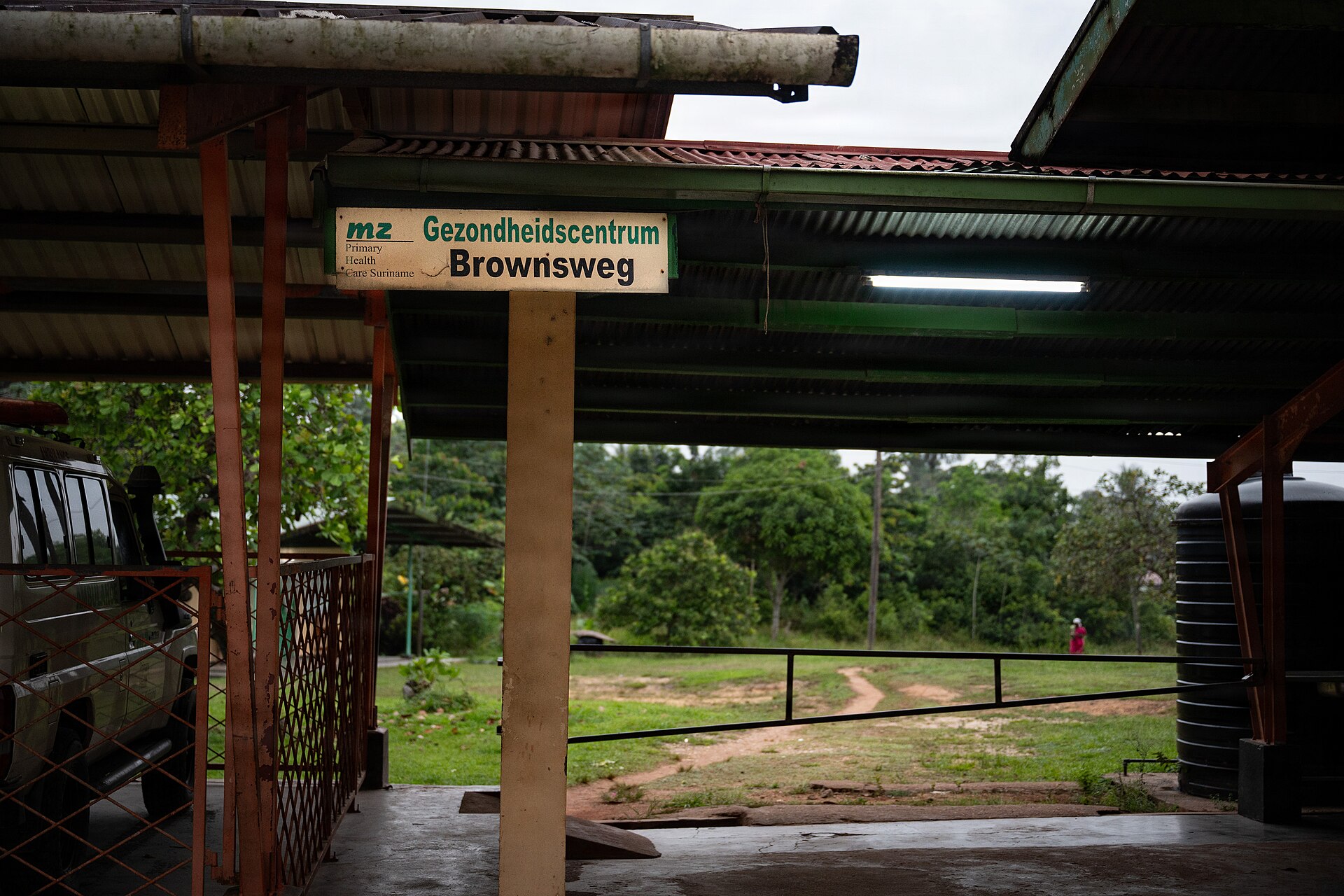
MZ relies on small planes and boats. As of September 2026 it had received no operating funds for 2026, and its debts had passed SRD 14 million (about US$370,000).
Some airlines no longer fly for MZ because of unpaid bills, its managers told de Ware Tijd. That affects emergency flights, supplies and staff rotations.
Regional hospitals are being upgraded. The Marwina hospital in Albina received a loan of 5 million euros (about US$5.7 million) from the French development agency AFD.
The Atjoni hospital has about four Cuban doctors. It is meant to become the first stop for the more than 20,000 people of Upper Suriname. Serious cases are still flown or driven to Paramaribo.
Vaccines, mosquitoes and the malaria-free milestone
The World Health Organization certified Suriname malaria-free on 30 June 2025, the first country in the Amazon region to do so. The US CDC now advises bite prevention only, not malaria pills.
Yellow fever is the key vaccine. The CDC recommends it for all travellers aged nine months or older.
Suriname requires proof of vaccination from travellers aged one or older arriving from countries with yellow fever risk. That includes airport layovers of more than 12 hours there, but not direct travel from the United States.
Other mosquito-borne viruses remain. Chikungunya returned in January 2026 after about a decade. By late February, 1,150 people had fallen ill, according to the Dutch public health institute RIVM.
On 10 August 2026 the Bureau of Public Health (BOG) said the epidemic phase was over but the virus had become endemic. The CDC also lists dengue and Zika among the risks.
The CDC recommends hepatitis A vaccine and suggests considering typhoid vaccine for longer stays. Repellent, long sleeves and screened rooms remain the main defence.
What the Simons government and oil money may change
Parliament elected Jennifer Geerlings-Simons, a physician, as Suriname’s first woman president on 6 July 2025. She took office on 16 July, with Misiekaba as health minister.
Misiekaba describes two phases: recovery first, then structural reform. He said in September 2026 that recovery should last until mid-2027, possibly until the end of that year.
The centrepiece is an SRD 635 million (about US$16.8 million) programme at the AZP, launched on 25 June 2026. It covers the emergency department, intensive care, laboratories, radiology, equipment and a crash course for 200 nurses.
First results are due by February 2027, the minister has said. Nurses get a bridging allowance, and in September 2026 a framework set a new pay scale of US$700 to US$1,000 a month. Final terms are expected in November.
Oil is the long-term hope. TotalEnergies approved the US$10.5 billion GranMorgu offshore project in October 2024, with first oil expected in 2028.
State oil company Staatsolie puts Suriname’s income from the field at US$16 billion to US$26 billion over its life. The range depends on oil prices. At the AZP launch, Simons said oil and gas money must be invested responsibly in weak sectors.
The International Monetary Fund urged caution in May 2026. It said health and education investment should rise only gradually. It also said the savings and stabilisation fund must still be made operational.
For a foreigner, the practical reading is simple. Plan around today’s system of healthcare in Suriname, not the one promised for the oil years.
Connected Coverage
Suriname Visa and Residency 2026 — Entry Fees, Permits and Timelines
Geerlings-Simons Takes Charge of Suriname Economy as TotalEnergies Prepares 2028 Oil
ExxonMobil Drives Guyana Oil Boom Past 900,000 Barrels Daily as Suriname Race Heats Up
Sources: Insurance rules come from the Government of Suriname, the basic-insurance body and the State Health Fund. Hospital, medicine and budget facts come from ministry statements, the IMF and Surinamese press. Disease guidance comes from WHO, the US CDC and RIVM, all accessed 25 September 2026.
- gov.sr — basic health insurance
- basiszorg.sr — basic insurance act
- szf.sr — personal policy premiums
- gov.sr — AZP readiness programme
- gov.sr — regional hospitals
- gov.sr — chikungunya update
- cbvs.sr — Central Bank of Suriname rates
- medischezending.sr
- who.int — malaria-free certification
- cdc.gov — Suriname travel health
- travel.state.gov
- gov.uk — Suriname health advice
- knmg.nl — Surinamese doctors in training
- lumc.nl
- imf.org — Country Report 26/131
- staatsolie.com — GranMorgu decision
- World Bank — health spending per person
What Is Not Known
Whether the SRD 635 million (about US$16.8 million) AZP programme will deliver by February 2027 is not known. The health minister has not published an itemised budget or a full timetable for the wider reforms.
The total debt of the health sector is not known. Published figures cover only the AZP and the medicine importer BGVS. The Diakonessenhuis and the regional hospitals have not disclosed complete totals.
How many patients the ARMULOV scheme sends abroad each year, and how many it refuses, is not published. Local commentators have asked for the committee’s criteria and figures.
How much oil revenue will reach hospitals is not known. First oil is expected in 2028, and the IMF says the savings fund and fiscal rules are not yet working.
Whether chikungunya or dengue will surge again cannot be predicted. Health officials say chikungunya is now endemic and ask residents to clear mosquito breeding sites.
Frequently Asked Questions
Is healthcare in Suriname good enough for expats?
Routine care in Paramaribo is cheap by US standards, with family-doctor visits capped at about US$16 to US$25. But hospitals are indebted, medicines run short and complex cases are sent abroad, mostly to Colombia. Expats should carry insurance that covers evacuation.
Do foreigners living in Suriname need health insurance?
Yes: since 9 October 2014 the basic health insurance law has obliged every resident, foreigners included, to hold basic cover. The state pays premiums only for Surinamese nationals aged up to 16 or 60 and over. Foreigners buying a State Health Fund policy must pay 12 months up front.
How much does a doctor visit cost in Suriname?
The VMS medical association caps a regular weekday family-doctor consultation at US$16.25, paid in SRD at the central bank rate. Non-residents pay 35 euros, about US$40. One Paramaribo practice charges self-paying patients SRD 800, about US$21, and non-residents SRD 1,600, about US$42.
Which vaccines do I need for Suriname?
The US CDC recommends yellow fever vaccine for all travellers aged nine months or older. Suriname requires proof from travellers aged one or older arriving from yellow fever risk countries, including layovers over 12 hours there. WHO certified the country malaria-free in June 2025, so the CDC advises only bite prevention.
Does Dutch health insurance cover me if I move to Suriname?
Usually not, because Suriname has no health-care treaty with the Netherlands. Dutch basic insurance is tied to living in the Netherlands, so people who move need local or international cover. Short visits usually stay covered, with limits on costs abroad.
What number do I call in a medical emergency in Suriname?
Dial 115, the national emergency number; British travel advice also lists 113 for an ambulance. The main emergency department is at the Academic Hospital Paramaribo, and a 24-hour family-doctor emergency post operates on Frederik Derbystraat. Some operators may not speak English.
This article was produced by The Rio Times’ automated newsroom system. How we use AI · Report an error
Read More from The Rio Times