Key Facts
- Vale’s New York shares settled at US$14.72, down 1.47 per cent, while its São Paulo line VALE3 fell 1.66 per cent to R$75.39 (US$14.75).
- CSN Mineração, the separately listed iron ore arm of Brazil’s CSN, fell 2.54 per cent to R$5.75 (US$1.13), the steepest drop among the iron ore names tracked here.
- Rio Tinto’s New York-listed shares dropped 1.83 per cent to US$99.65, reflecting a broad withdrawal from diversified miners on the day.
- Copper barely moved by comparison, with the US Copper Index Fund easing 0.22 per cent to US$40.76 after closing at its best level since late January on Wednesday.
- China’s steel-intensive construction pipeline is the market’s stated worry, the demand signal traders cite when marking down seaborne iron ore exposure.
- The Ibovespa fell 1.23 per cent to 175,546.36, so the mining names underperformed a market that was already broadly lower.
Today’s Focus
Iron ore-linked equities fell across the board on Thursday. CSN Mineração led the move lower, sinking 2.54 per cent, while Vale’s ADRs gave up 1.47 per cent and Rio Tinto lost 1.83 per cent.
The declines were far steeper than copper’s. The US Copper Index Fund slipped just 0.22 per cent to US$40.76, holding within a fraction of its best level since late January set on Wednesday. That resilience did not spill into ferrous markets, because the copper narrative rests on tight physical supply and grid-related demand.
Iron ore, in contrast, remains captive to the rhythm of Chinese steel blast furnaces. Beijing’s push to cool the property sector has left a pipeline of stalled construction projects, shrinking the near-term appetite for the high-grade Brazilian fines that Vale specialises in.
A firmer real gave no shelter. The dollar eased 0.20 per cent to R$5.1104, a move far too small to offset the fall in the underlying shares.
What matters today. The listed iron ore names slipped because nothing in the copper trade could offset the market’s read on flagging Chinese construction steel demand.

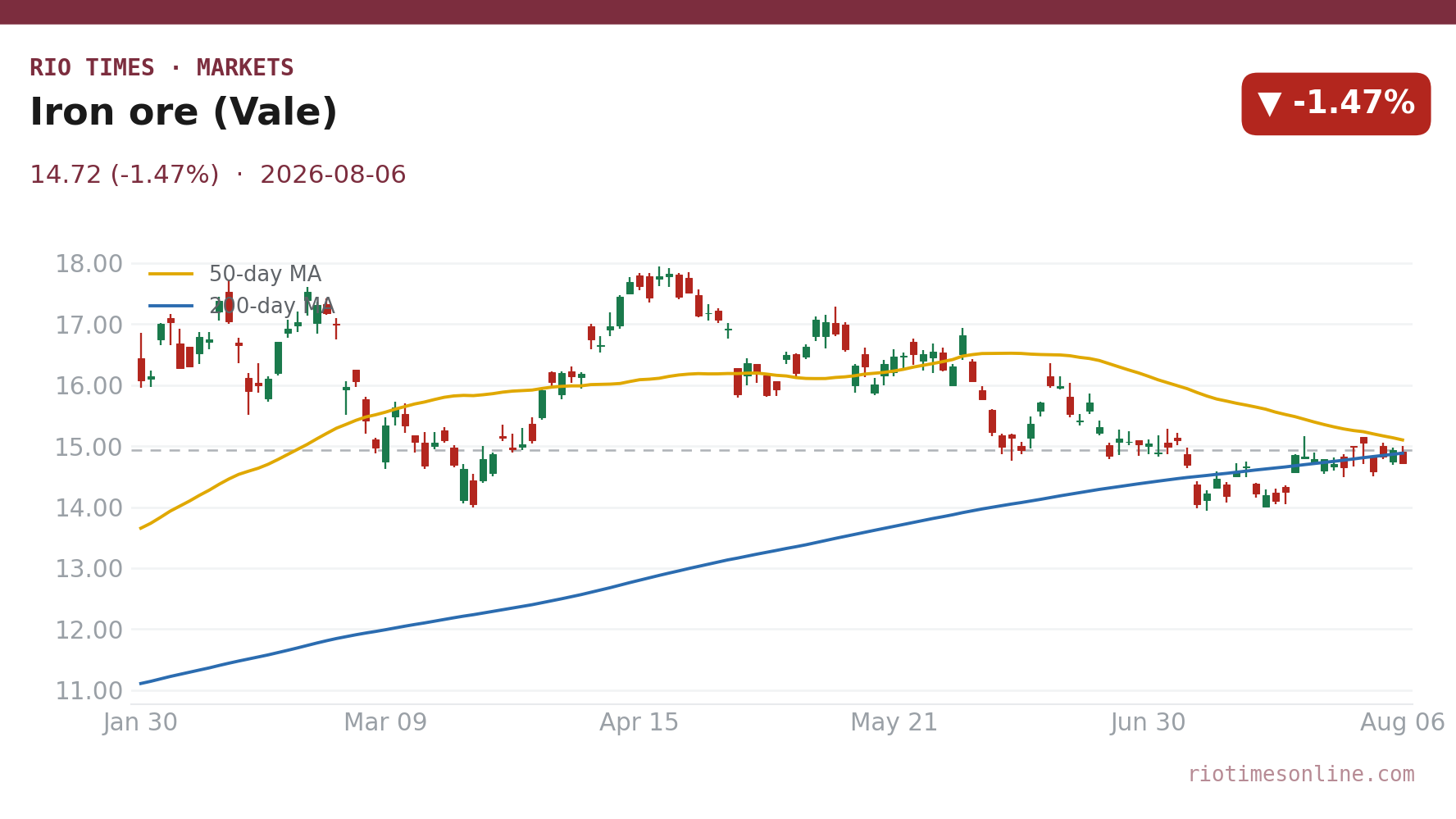
01 The session in one read
Shares of Vale, CSN Mineração and Rio Tinto all retreated on Thursday, dragged lower by a weakening outlook for China’s steel mills. The three stocks are among the most liquid listed proxies for iron ore demand, and they painted a unanimously red picture for the ferrous sector.
CSN Mineração suffered the worst of the selling, dropping 2.54 per cent to R$5.75 (US$1.13). Vale’s New York-traded ADRs fell 1.47 per cent to US$14.72 and its B3 line eased 1.66 per cent to R$75.39 (US$14.75), while Rio Tinto’s New York listing gave up 1.83 per cent to settle at US$99.65.
A clear divergence defined Thursday’s session: industrial metals split into two camps. The US Copper Index Fund eased just 0.22 per cent, holding beside its best level since late January set on Wednesday, while the listed iron ore complex retreated far harder. That split suggests the market is not trading a general commodity super-cycle but a far more specific story in copper. For iron ore, traders latched onto Chinese steel mill margins and property starts. The variable to watch is Beijing’s next fiscal stimulus signal, because without fresh infrastructure pledges these iron ore equities will struggle to detach from the demand question hanging over them.
02 The board
The moves show a sector-wide de-rating rather than a company-specific story. CSN Mineração, a standalone Brazilian pure-play on iron ore, carries a higher beta to the underlying commodity, a factor neatly captured by its larger decline.
Rio Tinto’s fall of nearly 2 per cent confirmed that the selling pressure swept across even the most diversified portfolios. Traders appeared indifferent to the company’s aluminium and copper income streams, focusing on the iron ore division where earnings growth is now under scrutiny.
| Asset | Level | Change |
|---|---|---|
| Vale (NYSE ADR) | US$14.72 | -1.47% |
| Vale (B3, VALE3) | R$75.39 · US$14.75 | -1.66% |
| CSN Mineração (B3, CMIN3) | R$5.75 · US$1.13 | -2.54% |
| Rio Tinto (NYSE) | US$99.65 | -1.83% |
| Copper (CPER ETF) | US$40.76 | -0.22% |
| Ibovespa | 175,546.36 | -1.23% |
Source: RT close, 2026-08-06. Real conversions at US$1 = R$5.1104. No spot iron ore feed is used; listed producers and an exchange-traded copper tracker are shown as labelled proxies.
Live Market IntelligenceThe live market board
Rio Times · Live Market Intelligence
Latin America — Cross-Market Board
| Instrument | Last | Change | YoY | Prev. | High | Low | Volume |
|---|---|---|---|---|---|---|---|
| IBOV | 167,874.64 | -2.50% | +24.22% | 172,179.93 | 172,386 | 168,470 | — |
| IPSA | 11,128.56 | -1.25% | — | 11,268.86 | 11,308 | 11,084 | 1,513,213,483 |
| IPC MEX | 66,438.58 | -0.75% | +12.70% | 66,938.64 | 66,459 | 65,637 | 28,754,163 |
| MERVAL | 3,022,485 | -3.19% | +32.12% | 3,122,065 | 3,185,663 | 3,041,807 | — |
| COLCAP | 2,423.37 | +2.14% | — | 9.04 | 9.05 | 9.02 | 4,133 |
| BVL PERÚ | 59,693.55 | -1.60% | — | — | — | — | — |
| USD/BRL | 5.16 | +1.01% | -5.00% | 5.11 | 5.17 | 5.10 | — |
| EUR/BRL | 5.95 | +1.45% | -5.81% | 5.87 | 5.96 | 5.89 | — |
| USD/MXN | 17.10 | -0.22% | -7.96% | 17.14 | 17.16 | 17.10 | — |
| USD/CLP | 913.58 | -0.40% | -5.60% | 917.27 | 916.37 | 912.70 | — |
| USD/COP | 3,116 | -1.26% | -22.91% | 3,156 | 3,144 | 3,104 | — |
| USD/PEN | 3.38 | -0.09% | -2.62% | 3.38 | 3.38 | 3.36 | — |
| USD/ARS | 1,493 | -0.39% | +12.66% | 1,498 | 1,498 | 1,490 | — |
| USD/UYU | 40.23 | +1.56% | +1.70% | 39.61 | 40.25 | 40.23 | — |
| USD/PYG | 5,925 | +1.88% | -19.59% | 5,816 | 5,925 | 5,922 | — |
| USD/BOB | 11.72 | +0.37% | +74.16% | 11.68 | 11.80 | 11.72 | — |
| USD/DOP | 58.20 | +1.20% | -3.49% | 57.51 | 58.20 | 58.05 | — |
| USD/CRC | 447.79 | +1.51% | -9.36% | 441.12 | 447.88 | 446.85 | — |
Live Company IntelligenceVale SA ADR — the full investor dossier
Wall Street view
Valuation & profitability
Price & risk
$9.1852-wk high
$17.94
Revenue trend · 6y
Ownership
Dividend
03 What moved it
Capital clearly favoured the industrial metals commanding a structural premium. Copper’s push to its best level since late January on Wednesday kept speculative attention away from iron ore even as the metal itself paused on Thursday. Fund money has been rotating out of China-stimulus plays and into metals tied to the energy transition and the grid build-out.
That rotation showed up elsewhere in the session. Albemarle, the lithium producer, jumped 5.54 per cent to US$125.42 and Chile’s SQM added 3.43 per cent in New York. Southern Copper, by contrast, fell 2.02 per cent to US$193.03, a reminder that the miners do not always track the metal they dig.
04 The Latin American read
For Brazil, the CSN Mineração sell-off is a direct barometer of investor anxiety over the country’s primary commodity engine. A drop of more than 2.5 per cent in a single session signals a discounting of the high-premium fines that dominate Brazil’s exports.
Currency offered no cushion. The dollar slipped 0.20 per cent to R$5.1104, a marginally stronger real that neither amplified nor absorbed the equity move. For foreign investors holding Vale ADRs, the 1.47 per cent decline in New York tracked the 1.66 per cent fall in São Paulo closely, confirming that the selling was in the shares rather than in the currency.
05 The names to watch
Vale remains the vital watchpoint: its ADR at US$14.72 now sits at a level that challenges the view that China will restock heavily in the third quarter. Any fresh signal from Beijing’s housing ministry on completing stalled residential projects could arrest this slide.
The session also rewarded electrification metals. Albemarle’s 5.54 per cent rally on lithium came as the traditional steel supply chain was marked down. That de-coupling makes diversified names like Rio Tinto, which lost 1.83 per cent despite owning lithium assets, a complex trade in the short run.
06 The outlook
The path forward for iron ore equities hinges on Chinese rebar demand and mill margins rather than on global growth sentiment. Should copper hold near its highs while the ferrous names slump further, it would point to a lasting split in which steel ingredients trade on their own fundamentals. For the next sessions, traders will scrutinise blast-furnace capacity utilisation rates out of Tangshan.
07 What to watch
- Tangshan blast-furnace rates: These weekly Chinese utilisation figures are the closest available read on Vale’s sales book; a sustained drop would signal a fresh leg down for the iron ore names.
- Beijing property policy: Any concrete fiscal package aimed at finishing stalled housing projects would immediately reprice seaborne iron ore demand from Brazil.
- Vale’s cost guidance: The company lifted its 2026 iron ore cost guidance this week, and further cost drift would compound the demand problem.
- Copper ratio trade: The spread between copper near its best level since late January and falling iron ore stocks reveals a structural rotation; a sustained copper rally would keep ferrous names out of favour.
Frequently Asked Questions
Why did Vale shares fall on Thursday?
Vale’s ADRs fell 1.47 per cent to US$14.72 and its B3 line lost 1.66 per cent to R$75.39 (US$14.75), as the market marked down exposure to Chinese steel demand and rotated toward energy-transition metals such as copper and lithium.
Why did CSN Mineração drop more than Vale?
CSN Mineração is a pure-play iron ore producer with a smaller free float and a higher beta to the commodity. It fell 2.54 per cent to R$5.75 (US$1.13), a sharper move than Vale’s because it lacks the buffer of a diversified base-metals portfolio.
Are copper and iron ore now opposing trades?
On Thursday they moved apart. The US Copper Index Fund eased just 0.22 per cent to US$40.76 and stayed beside Wednesday’s best level since late January, while the listed iron ore names fell far harder. That divergence shows capital is not treating the two industrial commodities as a single bloc.
What does Rio Tinto’s drop tell us?
Rio Tinto’s New York listing lost 1.83 per cent to US$99.65, which shows the market pricing in earnings downside from its Pilbara iron ore division, outweighing the group’s copper and lithium exposure.
This article was produced by The Rio Times’ automated newsroom system. How we use AI · Report an error
LatAm Markets: Live Signals → — real-time movers, turnover leaders and FX across Latin America.
Read More from The Rio Times