Iron Ore Drops on China Steel Fears as Brazil’s Vale Sinks 3%
Key Facts
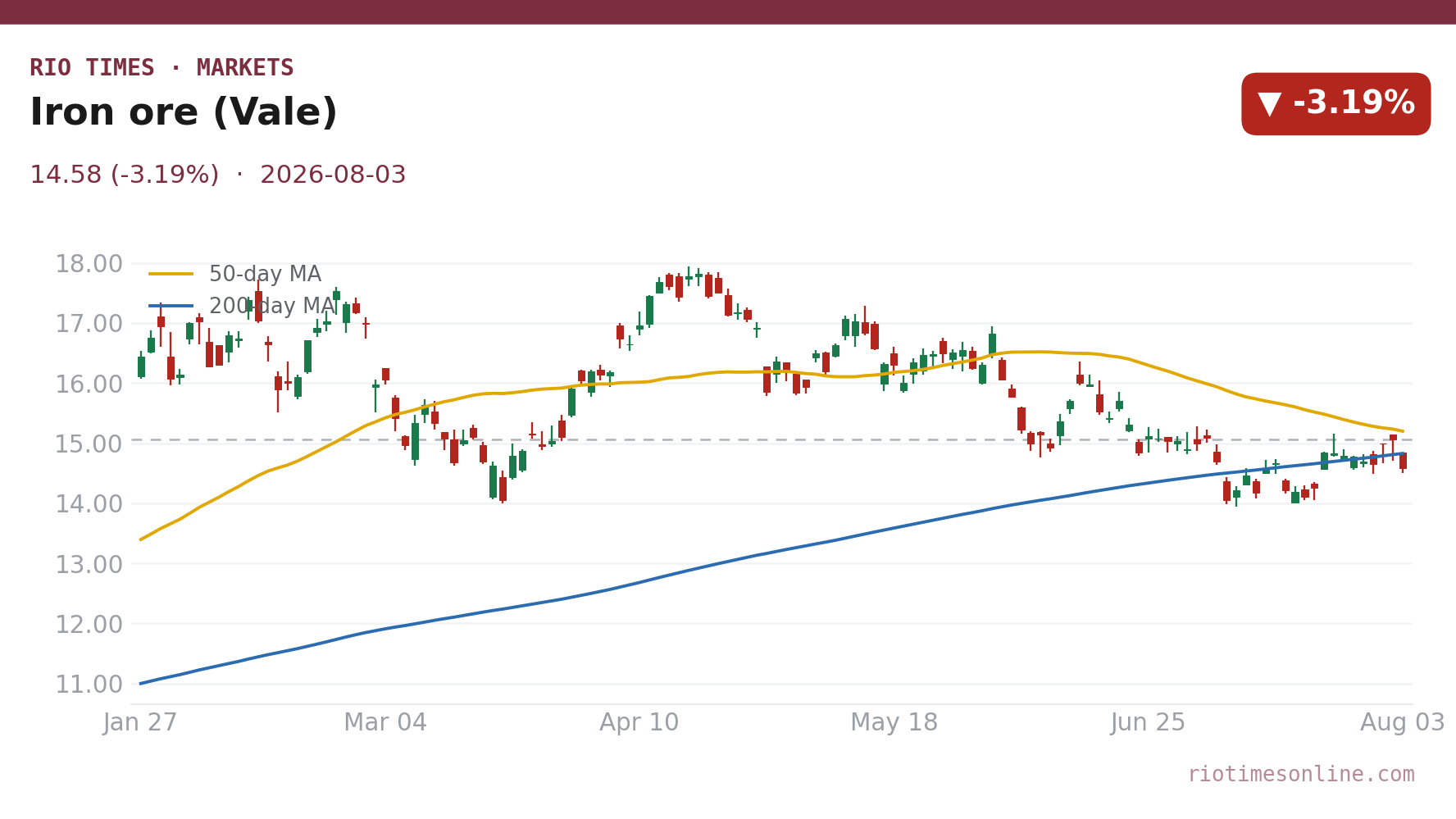
- Vale’s New York-listed ADR fell 3.19% to US$14.58 on Monday, 3 August, the equity proxy most foreign investors use to track seaborne iron ore prices into China.
- Iron ore futures hit their lowest level in more than a year, retreating as much as 1.9% to US$94.10 a tonne in Singapore, while the most-traded Dalian contract fell almost 3%.
- Brazil’s CSN Mineração was the lone outlier, edging up 0.35% to R$5.73 (about US$1.13), converted at Monday’s closing rate of R$5.0882 to the US dollar.
- Rio Tinto’s US-listed stock slipped 0.98% to US$95.90, reflecting the same caution among the Australian majors feeding China’s blast furnaces.
- Chinese mill margins weakened again and hot-metal output fell for a fourth straight week, with construction activity at its weakest since the start of the pandemic and factory activity contracting in July for the first time in five months.
- A credit scare around physical trader Radiant World deepened the sell-off, after Vitol and Cargill halted business with the firm over invoice concerns. Radiant World called the reports “categorically untrue”.
Today’s Focus
Iron ore proxies fell on Monday, 3 August, as China’s steel complex absorbed a fresh credit scare on top of an already weak demand picture. Vale’s American Depositary Receipt, the most liquid iron ore equity proxy for global investors, closed at US$14.58, down 3.19% from Friday’s US$15.06. The ADR gives foreign buyers direct dollar-denominated exposure to Brazil’s largest miner, which ships the bulk of its ore to Chinese blast furnaces.
The selling had a clear cause. Futures for the steelmaking ingredient dropped as much as 1.9% to US$94.10 a tonne in Singapore, the lowest intraday level since early July 2025, while the most-traded Dalian contract fell close to 3%. Chinese mill margins had weakened further the previous week, hot-metal output declined for a fourth consecutive week, and construction activity slumped to its lowest level since the start of the pandemic. No policy headline came close to offsetting any of it.
Brazil’s CSN Mineração was the session’s one bright spot, adding 0.35% to finish at R$5.73 — about US$1.13 at Monday’s closing rate of R$5.0882 to the dollar — on the São Paulo exchange. Rio Tinto, Vale’s Australian rival and fellow China supplier, fell 0.98% to US$95.90. The divergence reflected different investor bases and currencies rather than different views: both miners ultimately answer to the same Chinese customer.
Foreign investors watching from outside Brazil have no iron ore spot price on the Rio Times feed. Instead they follow the equity proxies: Vale in New York, CSN Mineração in reais, and global miners like Rio Tinto. On Monday those instruments translated a genuinely weak session in the physical ore market into a negative equity picture.
What matters today. Iron ore proxies fell because weak Chinese construction demand and a trader credit scare overwhelmed anything on the policy side, with Vale’s ADR down 3.19% to US$14.58.

01 The session in one read
Iron ore equity proxies fell on Monday, 3 August, as a credit scare around one of the market’s largest physical traders landed on top of steel fundamentals that were already deteriorating. Vale’s New York-listed ADR changed hands at US$14.58, down 3.19% from its prior close of US$15.06.
The ADR is the most direct, liquid proxy available to foreign investors who cannot see a live spot iron ore price on their terminal — Vale’s revenue is overwhelmingly tied to the fines and pellets shipped from its Brazilian mines to Chinese steelmakers. On Monday that proxy told a straightforward story: a market with no bid. The damage was not confined to the miners, either. Brazil’s steelmakers took a harder hit in the same session, with CSN’s São Paulo-listed shares dropping 6.82% while Ternium gained.
The 3.19% drop suggests iron ore markets are repricing toward a genuine surplus rather than pausing before a recovery. With Singapore futures at a one-year low near US$94 a tonne and Vale’s ADR at US$14.58, the burden of proof has shifted decisively to the demand side: short of a real pickup in Chinese steel orders or an unexpected supply disruption, proxies have little to arrest the slide. The variable to watch is any official announcement from China’s housing ministry on presale delivery guarantees, which would translate directly into rebar demand, steel mill margins and ultimately the loading schedules at Vale’s Brazilian ports.
02 The board
Three equity instruments capture the iron ore complex for Rio Times readers, each quoted in its native currency. Vale’s US-dollar ADR at US$14.58 anchors the board, representing the world’s largest seaborne iron ore exporter. In São Paulo, CSN Mineração gained 0.35% to close at R$5.73 — roughly US$1.13 at Monday’s closing exchange rate of R$5.0882 per US dollar — the only positive print among the major proxies.
That move in CSN Mineração, a smaller but pure-play Brazilian iron ore miner, looks more like bargain-hunting after a sharp slide than a vote of confidence: the stock had shed 4.5% over the two preceding sessions, closing at R$5.98 (about US$1.17) on 29 July and R$5.71 (about US$1.13) on 31 July, before Monday’s modest bounce. Rio Tinto, the London and New York-traded Australian giant, fell 0.98% to US$95.90, giving back part of an earlier advance as traders pushed back the timing of any China demand recovery.
| Asset | Level | Change |
|---|---|---|
| Iron ore (Vale) | US$14.58 | -3.19% |
| CSN Mineração | R$5.73 (US$1.13) | +0.35% |
| Rio Tinto | US$95.90 | -0.98% |
Source: RT close, 2026-08-03. Real figures converted at that session’s close of R$5.0882 per US dollar. Where a commodity has no spot feed, an exchange-traded tracker or leading producer is shown as a labelled proxy.
Live Market IntelligenceThe live market board
Rio Times · Live Market Intelligence
Latin America — Cross-Market Board
| Instrument | Last | Change | YoY | Prev. | High | Low | Volume |
|---|---|---|---|---|---|---|---|
| IBOV | 167,874.64 | -2.50% | +24.22% | 172,179.93 | 172,386 | 168,470 | — |
| IPSA | 11,128.56 | -1.25% | — | 11,268.86 | 11,308 | 11,084 | 1,513,213,483 |
| IPC MEX | 66,438.58 | -0.75% | +12.70% | 66,938.64 | 66,459 | 65,637 | 28,754,163 |
| MERVAL | 3,012,063 | -3.52% | +32.12% | 3,122,065 | 3,185,663 | 3,041,807 | — |
| COLCAP | 2,427.20 | +2.31% | — | 9.04 | 9.05 | 9.02 | 4,133 |
| BVL PERÚ | 59,693.55 | -1.73% | — | — | — | — | — |
| USD/BRL | 5.16 | +1.01% | -5.00% | 5.11 | 5.17 | 5.10 | — |
| EUR/BRL | 5.95 | +1.45% | -5.81% | 5.87 | 5.96 | 5.89 | — |
| USD/MXN | 17.10 | -0.22% | -7.96% | 17.14 | 17.16 | 17.10 | — |
| USD/CLP | 913.58 | -0.40% | -5.60% | 917.27 | 916.37 | 912.70 | — |
| USD/COP | 3,116 | -1.26% | -22.91% | 3,156 | 3,144 | 3,104 | — |
| USD/PEN | 3.38 | -0.09% | -2.62% | 3.38 | 3.38 | 3.36 | — |
| USD/ARS | 1,493 | -0.39% | +12.66% | 1,498 | 1,498 | 1,490 | — |
| USD/UYU | 40.23 | +1.56% | +1.70% | 39.61 | 40.25 | 40.23 | — |
| USD/PYG | 5,925 | +1.88% | -19.59% | 5,816 | 5,925 | 5,922 | — |
| USD/BOB | 11.72 | +0.37% | +74.16% | 11.68 | 11.80 | 11.72 | — |
| USD/DOP | 58.20 | +1.20% | -3.49% | 57.51 | 58.20 | 58.05 | — |
| USD/CRC | 447.79 | +1.51% | -9.36% | 441.12 | 447.88 | 446.85 | — |
Live Company IntelligenceVale SA ADR — the full investor dossier
Wall Street view
Valuation & profitability
Price & risk
$9.1852-wk high
$17.94
Revenue trend · 6y
Ownership
Dividend
03 What moved it
The session’s decline came from two reinforcing pressures, not opposing ones. The first was a credit scare. Vitol and Cargill stopped doing business with Radiant World, a privately held physical trader that has grown into one of the market’s main players, over concerns about fake invoices, while Intesa Sanpaolo and Jefferies Financial Group’s Point Bonita fund reviewed their exposures. Radiant World said the reports were “categorically untrue”, but traders were left watching for any shift in market liquidity.
The second pressure was the physical reality inside China. Mill margins weakened further over the previous week, hot-metal output fell for a fourth straight week, construction activity slumped to its weakest since the start of the pandemic, and factory activity contracted in July for the first time in five months. Benchmark futures for 61% content ore have now posted three consecutive monthly losses, the longest such run in more than a year. Neither force gave Vale or CSN Mineração anything to lean on — and this was a sector story rather than a market-wide one, with the Ibovespa closing all but flat at about 178,000 points that session.
04 The Latin American read
For Latin America, iron ore is far more than a single company’s stock price. Brazil’s export revenue, its trade surplus with China, and the fiscal health of mineral-rich states like Minas Gerais and Pará all tie back to the same question: how much ore can Vale ship, and at a price that supports royalties, jobs and tax receipts. That is the same arithmetic behind Brasília’s push to widen mining’s contribution to national output, a strategy that could add US$37.8 billion to Brazil’s GDP through critical minerals.
Vale’s ADR at US$14.58 gives a US-dollar read on that entire chain, and Monday’s 3.19% fall is the market marking it down. The Rio Tinto figure of US$95.90 reminds Latin American exporters that competition from Australia’s Pilbara region remains intense, particularly on freight costs to northern Chinese ports. CSN Mineração’s small gain to R$5.73 (about US$1.13) shows Brazilian onshore investors reading the same weak signals through a local lens, cushioned by a marginally weaker real — R$5.0882 to the dollar at Monday’s close, against R$5.0754 on Friday — which lifts the reais value of dollar-priced ore revenues.
05 The names to watch
Vale is the dominant name for any foreign investor seeking Latin American iron ore exposure — its New York ADR provides instant, dollar-settled access. CSN Mineração offers a pure-play Brazilian alternative, listed in reais on the B3 exchange, with a narrower focus on the domestic mining and export chain.
Rio Tinto, while an Australian company, competes for exactly the same Chinese customers Vale serves, making its US-listed stock a useful cross-check. When Rio Tinto and Vale diverge sharply, it often signals a change in relative freight competitiveness or a shift in Chinese buyers’ preference for higher-grade Brazilian ore over Australian fines. For the wider macro backdrop against which these names traded, see Brazil’s financial morning call for 4 August 2026.
06 The outlook
The iron ore equity complex enters the rest of August with the burden of proof on the bulls. With Singapore futures at their lowest in more than a year and Vale’s ADR at US$14.58, it will take either a credible Chinese demand signal or a supply disruption to turn the trend; further disappointment in construction data would push the proxies to new lows. The absence of a decisive spot commodity price on most terminals means equity proxies will keep carrying an outsized signalling burden — and, as this session showed, they can move several percent on sentiment and counterparty risk before the physical market confirms anything.
07 What to watch
- China property presale delivery data: Any official guarantee of completion for stalled housing projects would boost rebar demand and directly lift Vale and CSN Mineração shares.
- Fallout from the Radiant World allegations: Further withdrawals by banks or trading houses could tighten liquidity in the physical ore market and add a risk premium to the equity proxies.
- Freight spread between Brazil and Australia to China: Widening or narrowing freight costs change Vale’s competitiveness against Rio Tinto, visible in their relative share price moves.
- Steel mill profit margins in Tangshan: Margins are the best real-time indicator of whether Chinese mills can afford high-grade Brazilian ore or will switch to cheaper Australian fines.
Related coverage: China steel demand lifts Vale and iron ore prices · Iron ore wrap: Vale rises as Rio Tinto jumps 2.52% · LatAm steel rallies as tariff shield meets auto hopes
Frequently Asked Questions
Why did Vale’s ADR fall 3.19% on 3 August 2026?
Vale’s New York-listed ADR closed at US$14.58 on Monday, 3 August, down 3.19% from Friday’s US$15.06. Iron ore futures hit a one-year low that day as Chinese mill margins weakened and hot-metal output fell for a fourth straight week, while a credit scare around physical trader Radiant World compounded already soft construction demand.
What is CSN Mineração’s R$5.73 close worth in US dollars?
CSN Mineração finished Monday, 3 August, at R$5.73 on Brazil’s B3 exchange, up 0.35% and the only gainer among the main iron ore proxies. At that session’s closing exchange rate of R$5.0882 to the US dollar, R$5.73 works out to roughly US$1.13 per share.
Where was the iron ore price on 3 August 2026?
Singapore futures for the steelmaking ingredient retreated by as much as 1.9% to US$94.10 a tonne, the lowest intraday level since early July 2025, while the most-traded Dalian contract fell almost 3%. Benchmark futures for 61% content ore had by then posted three consecutive monthly losses, the longest such run in more than a year.
How does China’s economy affect Brazilian iron ore stocks?
China produces more than half the world’s steel and buys most of Vale’s seaborne ore, so Chinese construction and infrastructure spending effectively sets the price. When property completions stall and mill margins compress, Vale, CSN Mineração and Rio Tinto tend to fall together, whichever exchange lists them and whatever currency they trade in.
Sources: Mining Weekly / Bloomberg, “Iron-ore hits one-year low on trader concerns and demand outlook”, 3 August 2026; Bloomberg; RT end-of-day closes for 3 August 2026 (VALE.US, RIO.US, CMIN3.SA and USDBRL.FOREX).
This article was produced by The Rio Times’ automated newsroom system. How we use AI · Report an error
LatAm Markets: Live Signals → — real-time movers, turnover leaders and FX across Latin America.
Read More from The Rio Times