Iron Ore Slips to Five-Week Low as China Steel Cuts Weigh on Vale
Updated 1 time · Latest: 29 September 2026
Key Facts
- Dalian futures hit a five-week low China’s most-traded January iron-ore contract was down 1.1% at 703.5 yuan (about US$105) a tonne in afternoon trade on Monday, September 28, 2026.
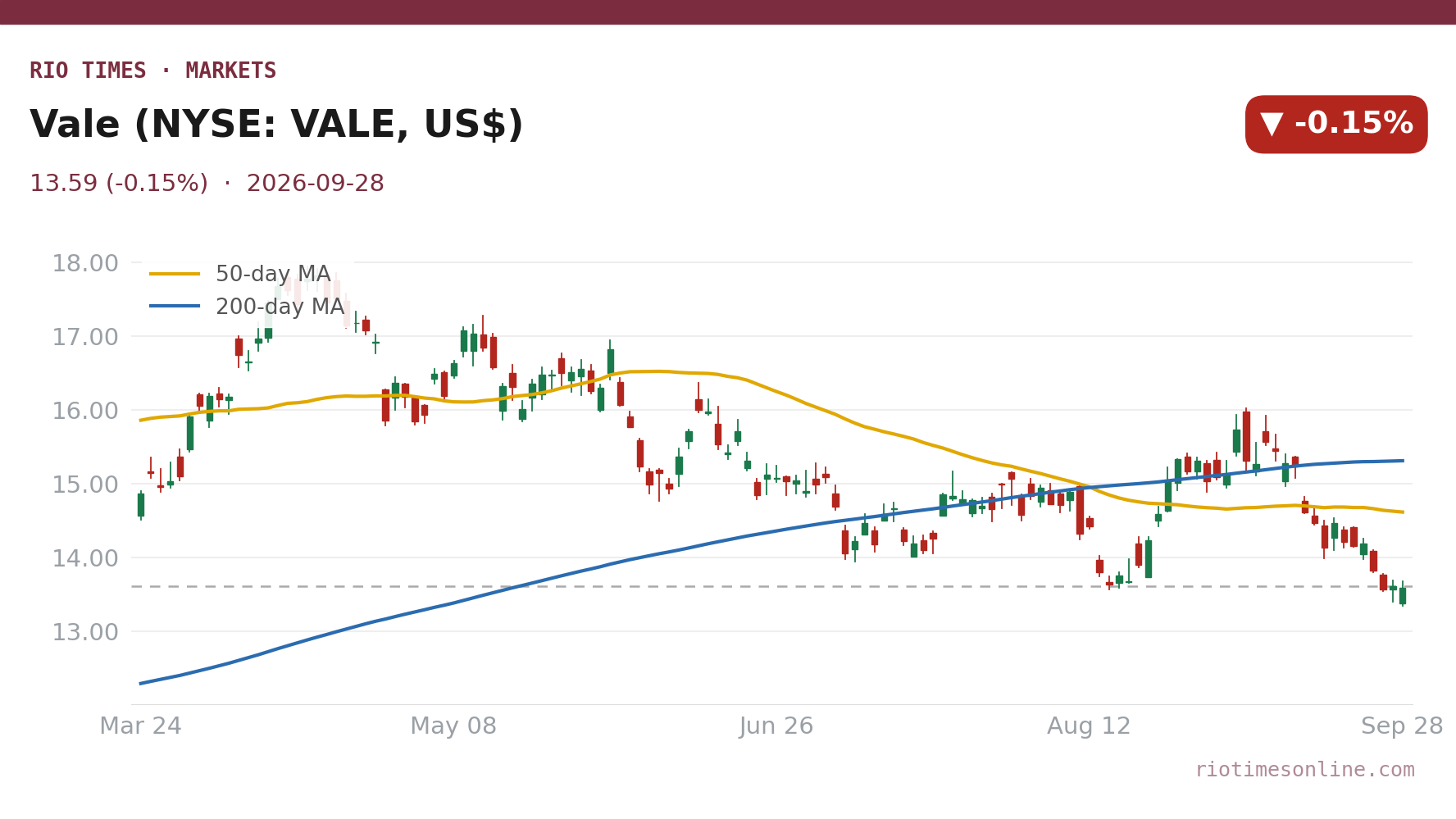
- Producers were mixed Vale’s New York shares closed at US$13.59, down 0.15%, while CSN Mineração rose 2.02% to R$5.05 (about US$0.97).
- Steel margins collapse Profits in China’s steel smelting and rolling sector fell 62.4% year on year in January to August, the National Bureau of Statistics said on Monday; overall industrial profits rose 15.7%, below the 18.0% forecast.
- China steel output is shrinking China’s crude-steel output fell 3.7% year on year in August and 3.1% during the first eight months of 2026.
- Singapore tracked the decline The October iron-ore contract traded at US$94.45 a tonne, down 0.68%, during the Asian afternoon.
- Mills are being told to restrain output China’s Iron and Steel Association urged mills to cut production as port inventories rose and profitability weakened.
- Holiday restocking provided limited support Buyers were not purchasing aggressively ahead of China’s National Day holiday starting October 1.
Today’s Focus
Iron ore slipped on Monday, September 28, 2026, as Chinese futures touched their lowest level since August 20. The most-traded Dalian contract was down 1.1% at 703.5 yuan (about US$105) a tonne in afternoon trade, while the Singapore October contract traded at US$94.45 a tonne, down 0.68%.
The story remains China’s shrinking steel industry. Crude-steel output fell 3.7% year on year in August, and the China Iron and Steel Association is urging mills to restrain production further.
Equity proxies were mixed. Vale’s New York shares slipped 0.15% to US$13.59, Rio Tinto eased 0.16% to US$94.41, but Brazil’s CSN Mineração rose 2.02% to R$5.05 (about US$0.97), rebounding after 11 straight losing sessions.
What matters today. China’s steel production cuts are the dominant force, and iron ore has no reason to rally until mills signal they are ready to buy again.
01 The session in one read
Iron ore benchmarks softened on Monday, September 28, 2026, as China’s steel production cuts continued to drag on demand. Dalian’s most-traded January contract was down 1.1% at 703.5 yuan (about US$105) a tonne in afternoon trade, after touching 700 yuan (about US$104), its lowest level since August 20.
The Singapore October contract traded at US$94.45 a tonne, down 0.68%, during the Asian afternoon. China’s National Day holiday begins on October 1, and buying by mills usually pauses during the week-long break.
Iron ore is caught between weak Chinese demand fundamentals and the approach of the National Day holiday, when buying typically pauses. The most-traded Dalian contract touched 700 yuan (about US$104), its lowest since August 20, and the Singapore October contract traded down 0.68% at US$94.45 a tonne. With crude-steel output falling 3.7% year on year in August and the China Iron and Steel Association urging further restraint, the demand picture is deteriorating. Monday’s official data sharpen the point: steel smelters’ profits fell 62.4% year on year in January to August, so mills have little cash to rebuild ore stocks. The variable to watch is whether Chinese port inventories keep rising after the holiday, which would signal that supply is still outrunning even restrained mill demand.
02 The board
Equity proxies for iron ore were mixed, reflecting a market searching for direction. Vale’s New York-listed shares closed at US$13.59, down 0.15%, while Rio Tinto ended at US$94.41, down 0.16%.
Brazil’s CSN Mineração bucked the trend, rising 2.02% to R$5.05 (about US$0.97). The rebound followed 11 straight losing sessions, and no company news explained it; one session does not make a trend.
| Asset | Level | Change |
|---|---|---|
| Iron ore (Vale) | US$13.59 | -0.15% |
| CSN Mineração | R$5.05 (US$0.97) | +2.02% |
| Rio Tinto | US$94.41 | -0.16% |
Source: RT close, 2026-09-28. Where a commodity has no spot feed, an exchange-traded tracker or leading producer is shown as a labelled proxy.
Live Market IntelligenceThe live market board
Rio Times · Live Market Intelligence
Latin America — Cross-Market Board
| Instrument | Last | Change | YoY | Prev. | High | Low | Volume |
|---|---|---|---|---|---|---|---|
| IBOV | 183,223.75 | +0.13% | +21.85% | 182,991.13 | 168,310 | 167,142 | — |
| IPSA | 11,064.58 | -0.66% | — | 11,137.59 | 11,210 | 10,984 | 1,513,213,483 |
| IPC MEX | 64,944.41 | -0.07% | +12.17% | 64,992.23 | 66,121 | 65,405 | 108,886,187 |
| MERVAL | 2,771,311 | -0.99% | +30.51% | 3,022,485 | 3,042,365 | 2,991,150 | — |
| COLCAP | 2,565.60 | -0.53% | — | 9.04 | 9.05 | 9.02 | 4,133 |
| BVL PERÚ | 60,220.45 | +0.02% | — | — | — | — | — |
| USD/BRL | 5.16 | +0.01% | -5.13% | 5.16 | 5.18 | 5.14 | — |
| EUR/BRL | 5.95 | +1.01% | -5.83% | 5.89 | 5.98 | 5.94 | — |
| USD/MXN | 17.06 | -0.24% | -8.58% | 17.10 | 17.08 | 17.01 | — |
| USD/CLP | 913.98 | +0.04% | -5.67% | 913.65 | 915.11 | 906.68 | — |
| USD/COP | 3,140 | +0.03% | -22.04% | 3,139 | 3,141 | 3,105 | — |
| USD/PEN | 3.36 | -0.66% | -4.82% | 3.38 | 3.38 | 3.35 | — |
| USD/ARS | 1,493 | +0.10% | +12.96% | 1,491 | 1,494 | 1,480 | — |
| USD/UYU | 40.27 | +1.24% | +1.80% | 39.77 | 40.27 | 40.23 | — |
| USD/PYG | 5,939 | +1.68% | -19.54% | 5,841 | 5,939 | 5,925 | — |
| USD/BOB | 11.64 | -0.76% | +72.04% | 11.73 | 11.72 | 11.64 | — |
| USD/DOP | 58.34 | +1.25% | -3.44% | 57.62 | 58.34 | 58.04 | — |
| USD/CRC | 445.92 | +0.89% | -9.71% | 441.97 | 448.50 | 445.92 | — |
03 What moved it
The fundamental driver is China’s steel industry, which is contracting under government pressure to reduce overcapacity and emissions. Crude-steel output fell 3.7% year on year in August and 3.1% over the first eight months of 2026.
The China Iron and Steel Association has urged mills to restrain output, and rising port inventories show supply is still outrunning demand. Weak mill profitability means steelmakers are in no hurry to restock iron ore, even with the National Day holiday approaching.
04 Monday’s data, one by one
Monday’s edition set five markers; the calendar added three releases.
Dalian’s 700-yuan line: tested, not broken. The January contract touched 700 yuan (about US$104), its lowest since August 20, but closed the day session at 705.0 yuan (about US$105), down 8.5 yuan.
China industrial profits (August): below forecast. Profits at large industrial firms rose 15.7% year on year in January to August, short of the 18.0% forecast and down from 17.6% for January to July; August alone grew 4.2%, the National Bureau of Statistics said. For ore, the split matters: steel smelting and rolling profits fell 62.4%, while mining profits rose 35.1%. Dalian stayed near its low after the 9.30 am Beijing release.
CISA guidance and Tangshan margins. No new output target came on Monday; the profit collapse is the day’s clearest margin signal.
Vale versus CSN Mineração: the spread widened. Vale fell 0.15% in New York while CSN Mineração rose 2.02% in São Paulo, a rebound after 11 losing sessions.
Post-holiday restocking. Not testable until after October 7.
Brazil’s external accounts (August). The Central Bank reported a current-account deficit of US$5.05 billion, against about US$4.9 billion expected and US$3.8 billion a year earlier. Direct investment was US$7.40 billion, against about US$6.9 billion expected.
US data and the Fed. The Dallas Fed factory index was 9.8, against 1.0 expected and 11.6 prior. Vice Chair for Supervision Bowman spoke on bank supervision, with no rate signal, and Richmond Fed President Barkin’s fireside chat left no published text. Governor Lisa Cook gave the day’s policy speech: she said AI-related productivity gains will not arrive in time to offset “the broadening inflationary pressure later this year.”
05 The Latin American read
For Brazil, the pressure on iron ore matters because Vale is one of the world’s two largest iron-ore exporters and the most direct link between China’s steel mills and Latin American commodity revenues. A sustained fall in the iron-ore price squeezes Vale’s earnings and, by extension, Brazilian export income.
CSN Mineração, the mining arm of Brazil’s CSN steel group, rose 2.02% to R$5.05 (about US$0.97) on Monday, a rebound after 11 straight losing sessions. But the broader global read is cautious: Vale and Rio Tinto both slipped, reflecting the same Chinese demand fears.
06 The names to watch
Vale remains the bellwether for Latin American iron-ore exposure. Its New York shares at US$13.59, down 0.15%, show investors are holding back until Chinese demand signals become clearer.
Rio Tinto, one of the world’s largest iron-ore producers, closed at US$94.41, down 0.16%, moving almost in lockstep with Vale. CSN Mineração’s 2.02% gain to R$5.05 (about US$0.97) is the outlier, a rebound after 11 straight losing sessions rather than a shift in global fundamentals.
07 The outlook
The near-term path for iron ore hinges on China’s post-holiday restocking patterns. If mills return from the National Day break and buy aggressively to rebuild inventories, prices could stabilise; if port stocks keep rising, the downtrend may extend.
With crude-steel output already down 3.1% in the first eight months of 2026, the structural demand story remains negative. Vale and its peers are likely to stay rangebound until there is concrete evidence that China’s steel production has found a floor.
08 What to watch
- China port inventories: Rising inventories signal supply is outrunning demand, which would pressure iron-ore prices further.
- Post-holiday restocking: If Chinese mills buy aggressively after October 7, prices could stabilise; weak buying would extend the decline.
- Steel output data: Any further cuts to Chinese crude-steel output would directly reduce iron-ore demand.
- Vale’s share price reaction: Vale at US$13.59 is the market’s most visible proxy for iron-ore sentiment; a break below recent levels could signal deeper pessimism.
- China PMIs: The NBS September manufacturing PMI (forecast 50.1, prior 49.8) prints at 01.30 UTC on Wednesday (10.30 pm Tuesday in Brasília), the last Chinese data before the Golden Week holiday.
Frequently Asked Questions
Why is iron ore falling?
China’s steel production is shrinking, with crude-steel output down 3.7% year on year in August, reducing demand for iron ore.
What is Vale’s role in the iron-ore market?
Vale is one of the world’s two largest iron-ore exporters, making its share price a direct proxy for global iron-ore sentiment.
What happened on Monday, September 28, 2026?
Dalian iron-ore futures were down 1.1% at 703.5 yuan (about US$105) a tonne in afternoon trade, while the Singapore October contract traded down 0.68% at US$94.45 a tonne.
Why did CSN Mineração rise when Vale fell?
CSN Mineração rose 2.02% to R$5.05 (about US$0.97), rebounding after 11 straight losing sessions, while Vale and Rio Tinto slipped on Chinese demand fears.
Source: RT live market data, close of Monday 28 September 2026.
This article was produced by The Rio Times’ automated newsroom system. How we use AI · Report an error
LatAm Markets: Live Signals → — real-time movers, turnover leaders and FX across Latin America.
Read More from The Rio Times