Key Facts
- The real weakened on Wednesday with the dollar closing at 5.1639 reais on the central bank PTAX rate, up 0.69%, as the broader dollar index ticked up.
- Argentina reports July consumer prices this evening with economists expecting a 2% monthly rise, keeping annual inflation near the 33.5% mark.
- More US retail data lands before the New York open and a soft reading could reinforce the case for another Federal Reserve rate cut, lifting risk appetite across the region.
- Mexico is still attracting speculative interest with traders holding a large net long position in the peso, according to the latest CFTC positioning data.
- Brazil publishes retail sales at 9am local time and any surprise on the upside would challenge the view that the central bank can keep cutting its Selic rate at speed.
Today’s Focus
Latin American markets open this Thursday morning with a nervous, data-dependent mood. The overnight session has not produced a single, dominant shock — instead, traders are juggling a heavy calendar that includes Argentine inflation, Brazilian retail sales and the US consumer.
The dollar is mixed against regional currencies. It rose slightly against the real but slipped against the Mexican peso, leaving the two largest Latin American markets facing very different opening pressures.
The more delicate spot is Buenos Aires, where the Merval — the blue-chip Argentine stock gauge — fell 0.76% on Wednesday. Tonight’s CPI number will test whether the government’s disinflation story has kept its momentum.
For the wider region, the key external signal will be US retail sales. A firm reading gives the Federal Reserve cover to keep interest rates higher for longer, which usually hits Brazilian and Mexican equities hardest because of their heavy foreign ownership.
What matters today. The two domestic inflation and sales prints will matter far more to today’s Latam session than any overnight move in US futures.

| Instrument | Level | Session |
|---|---|---|
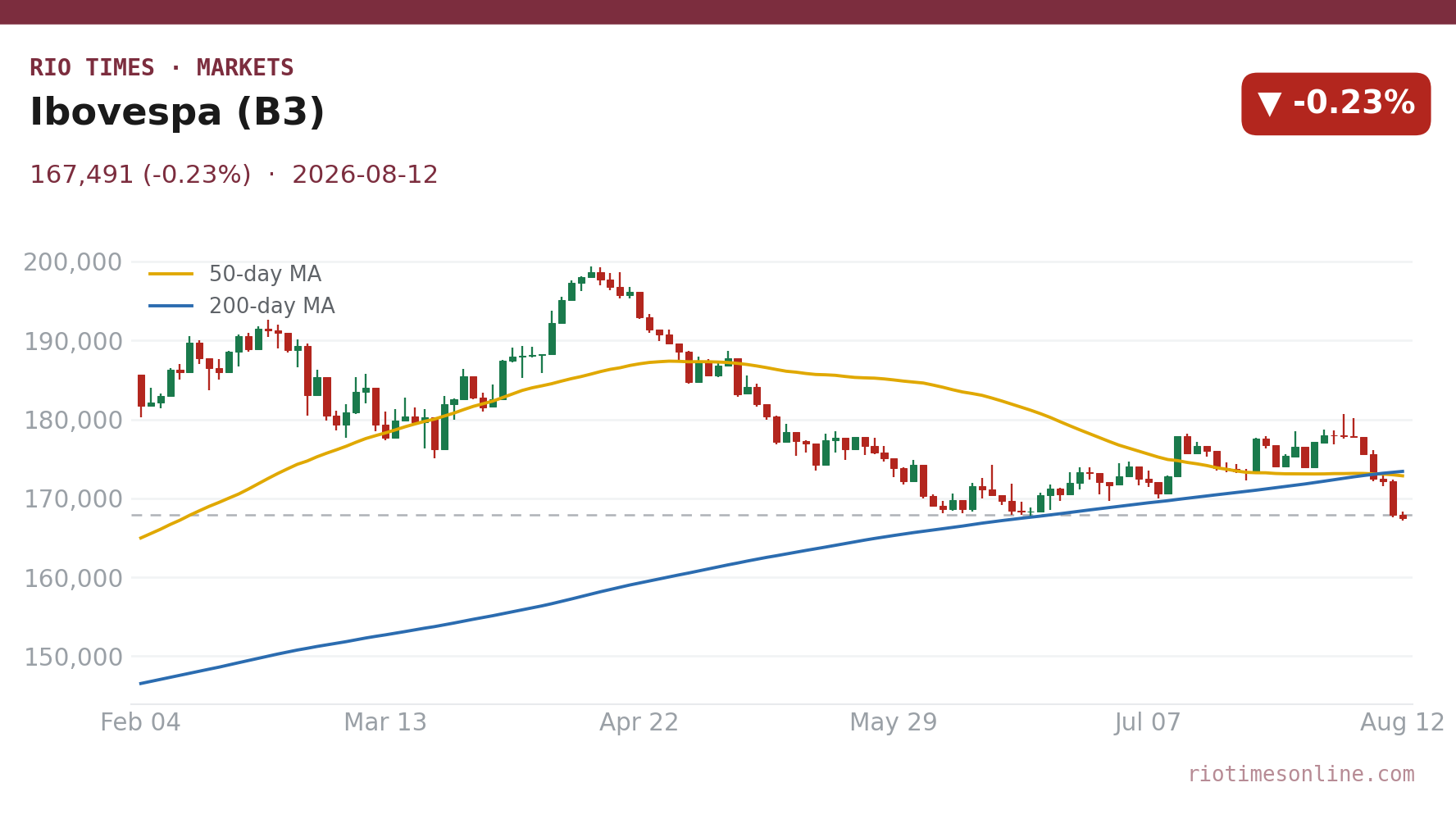
| Ibovespa (Brazil) | 167,491 | -0.23% |
| S&P 500 (US) | 7,748 | +0.26% |
| USD/BRL | 5.1639 | +0.29% |
| USD/MXN | 17.059 | -0.22% |
| USD/CLP | 914.82 | +0.13% |
| USD/COP | 3,123.28 | -0.13% |
| USD/ARS | 1,492 | +0.10% |
Source: RT close, 2026-08-12. Figures rendered directly from the feed.
01 The overnight tape in one read
This morning’s global tape is calm but not sleepy. Asian shares were largely steady, European bourses opened with modest gains, and US futures are pointing slightly higher after the S&P 500 inched up on Wednesday while the Dow Jones slipped nearly flat.
The VIX, Wall Street’s fear gauge, dropped almost 5% on Wednesday to the mid-14s — a sign that investors are not bracing for an immediate shock. But the futures tape is thin on conviction, and the bond market is telling a cautious story: the US 10-year yield eased to 4.68% from 4.70%.
One clear thread is precious metals. Gold jumped 0.90% to settle near US$4,406 an ounce and silver added 0.89% to US$65.14, as traders looked for havens that do not depend on US interest rates falling quickly.
That backdrop matters for Latam because regional markets are high-beta plays on global risk appetite. When the world changes little, the regional currencies and bourses are left to trade their own local stories — and there are enough of those today.
The evidence points to an open with no clear regional direction. The real, the peso and the sol are moving in opposite directions against the dollar, and Wednesday’s board showed Chile down hard while Colombia and Mexico edged up. The most important variable today is Argentina’s CPI print tonight, because a surprise on either side would swing Latin American risk sentiment quickly.
02 The board before the open
| Instrument | Level | Change | Read |
|---|---|---|---|
| USD/BRL | 5.1639 | +0.29% | Dollar firming vs the real |
| USD/MXN | 17.059 | -0.22% | Peso holding up despite data risk |
| USD/CLP | 914.82 | +0.13% | Peso flat-to-softer after IPSA slide |
| USD/COP | 3,123.28 | -0.13% | Colombia steady before activity data |
| Gold | US$4,414 | +0.98% | Safe-haven bid intact |
The most striking feature of the board is the split among Latin American currencies. The Mexican peso is the relative winner, easing the dollar lower, while the Brazilian real and the Chilean peso are facing mild upward pressure on the US currency.
The real’s weakness is worth watching because it comes on a day when Brazil releases its retail sales report. A weak real and a strong consumption figure would complicate the central bank’s plan to keep cutting the Selic rate. Rio Times · Live Market Intelligence
Live Market IntelligenceLatin America — Cross-Market Board
Latin America — Cross-Market Board
Instrument Last Change YoY Prev. High Low Volume
IBOV
167,491.07
-0.23%
+21.85%
167,874.64
168,310
167,142
—
IPSA
10,982.72
-1.31%
—
11,128.56
11,210
10,984
1,513,213,483
IPC MEX
65,860.95
+0.45%
+12.17%
65,564.76
66,121
65,405
108,886,187
MERVAL
2,999,524
-0.76%
+30.51%
3,022,485
3,042,365
2,991,150
—
COLCAP
2,430.45
+0.29%
—
9.04
9.05
9.02
4,133
BVL PERÚ
58,737.38
+0.13%
—
—
—
—
—
USD/BRL
5.16
+0.01%
-5.13%
5.16
5.18
5.14
—
EUR/BRL
5.95
+1.01%
-5.83%
5.89
5.98
5.94
—
USD/MXN
17.06
-0.24%
-8.58%
17.10
17.08
17.01
—
USD/CLP
913.98
+0.04%
-5.67%
913.65
915.11
906.68
—
USD/COP
3,140
+0.03%
-22.04%
3,139
3,141
3,105
—
USD/PEN
3.36
-0.66%
-4.82%
3.38
3.38
3.35
—
USD/ARS
1,493
+0.10%
+12.96%
1,491
1,494
1,480
—
USD/UYU
40.27
+1.24%
+1.80%
39.77
40.27
40.23
—
USD/PYG
5,939
+1.68%
-19.54%
5,841
5,939
5,925
—
USD/BOB
11.64
-0.76%
+72.04%
11.73
11.72
11.64
—
USD/DOP
58.34
+1.25%
-3.44%
57.62
58.34
58.04
—
USD/CRC
445.92
+0.89%
-9.71%
441.97
448.50
445.92
—
03 What the data shows — São Paulo’s money is rotating into cyclicals
| Stock | Move | Turnover | Note |
|---|---|---|---|
| EMBJ3 (Embraer) | +4.0% | R$827m | Best blue-chip gain, heavy volume |
| CMIN3 (CSN Mineração) | +3.9% | R$53m | Iron ore bid lifting miners |
| VTRU3 (Vitru) | +3.8% | R$24m | Education name, thin but positive |
| ARML3 (Armac) | -11.9% | R$16m | Worst fall of the day, very thin |
| PINE4 (Pine Bank) | -8.4% | R$32m | Mid-cap bank under pressure |
| PETR4 (Petrobras PN) | -2.2% | R$2.6bn | Oil heavyweight, biggest turnover |
The B3 board shows a very selective tape. The biggest turnover names — Petrobras and Vale — are not the day’s winners, suggesting that institutions are parking risk in liquid mega-caps while trading smaller, momentum-driven stories around them.
Embraer’s 4% jump on strong volume is the one move that has genuine depth. A Brazilian exporter rising while the real is weakening would be a classic hedge story, but the volume suggests more than just a flight to safety.
04 Brazil and the currencies
Brazil’s own macro calendar dominates this morning. Retail sales for June print at 9am Brasília time, with economists looking for a 2.4% annual gain after 0.4% in May. On the month, consensus is 0.3% against 0.1% previously. A strong number would support the economy’s resilience but also question how fast the central bank can cut the Selic rate further from 14.00% when the Copom next meets in September.
The central bank has delivered four straight cuts this year, taking the Selic from 15.00% on 19 March to 14.00% in August. For foreign bond investors, a slower cutting cycle means higher carry — a key reason the real has been a favourite the past month.
But the local story is not only about rates. The trade balance remains wide, and the currency is holding below the 5.20 per dollar mark despite a firmer US dollar index. That suggests enough dollar supply from exports to keep the real in a tight range.
Mexico’s peso is the other side of the coin: it has strengthened through the overnight session, and The CFTC’s Commitments of Traders report, published on Friday afternoon, will show how much speculative firepower is still pointed at the peso. The previous reading showed a large net long position, meaning the peso is more exposed to a sudden unwind if US data surprise on the strong side.
05 The regional setup
| Index | Country | Change |
|---|---|---|
| Ibovespa | Brazil | -0.23% |
| IPC | Mexico | +0.45% |
| IPSA | Chile | -1.31% |
| Merval | Argentina | -0.76% |
| COLCAP | Colombia | +0.29% |
| BVL Perú | Peru | +0.13% |
The regional board from Wednesday shows a clear north-south split. Mexico and Colombia gained while Brazil, Chile and Argentina fell, and that divergence is likely to persist until there is a clear signal from the data.
Chile’s IPSA fell the most, dropping more than 1.3%, which is notable because the Chilean peso barely moved. It suggests domestic investors are reducing equity risk, not foreign flows.
Colombia’s gain, by contrast, comes ahead of interesting activity data this afternoon — industrial production and retail sales. Both are expected to improve from prior prints, but the market is waiting to see if the consumer confidence reading confirms the more optimistic tone.
06 The technical picture
The technical layout for Brazil is the most fragile in the region. The Ibovespa is sitting far below its 52-week high and showing seven consecutive losing sessions, a streak that often attracts short-covering but can also accelerate if fresh selling appears.
Mexico’s IPC is in better shape, much closer to its 52-week high and still holding a positive medium-term trend. The peso’s strength reinforces that constructive equity picture.
Chile’s IPSA is interesting after the 1.3% slide. The index has not broken its wider range, but a second down day would put the 52-week support zone under pressure — especially with no major local catalyst until next week.
07 What to watch
- Argentina CPI tonight: A 2% monthly print would keep the annual inflation near 33.5%, and the market reaction will set the tone for the Merval on Friday.
- Brazil retail sales at 9am: A strong number could slow Brazil’s rate-cutting cycle and reverse the real’s overnight softness.
- US retail sales on Friday at 08:30 ET: A weak consumer reading would boost risk appetite across Latin America and lift the peso and real.
- Colombia industrial production: An expected 2.1% annual rise would support the COLCAP’s recent outperformance and keep flows into Bogotá alive.
Frequently Asked Questions
What is the Selic rate?
It is Brazil’s benchmark interest rate, set by the central bank’s policy committee. It currently stands at 14.0% after a 25-basis-point cut in August 2026.
Why is the Merval falling before the inflation data?
Argentina reported a 0.76% decline in its main stock index on Wednesday. Traders are cautious ahead of the CPI print because a hot number would delay any economic normalisation.
How do US retail sales affect Latin America?
Weak US consumption raises bets on Fed rate cuts, which weakens the dollar and lifts demand for higher-yielding emerging-market assets like Brazilian and Mexican stocks.
What is the Ibovespa?
It is Brazil’s main stock market index, tracking the most traded companies on the B3 exchange in São Paulo.
This article was produced by The Rio Times’ automated newsroom system. How we use AI · Report an error
LatAm Markets: Live Signals → — real-time movers, turnover leaders and FX across Latin America.
Read More from The Rio Times