Mexico Markets: IPC & the Peso — September 30, 2026
Key Facts
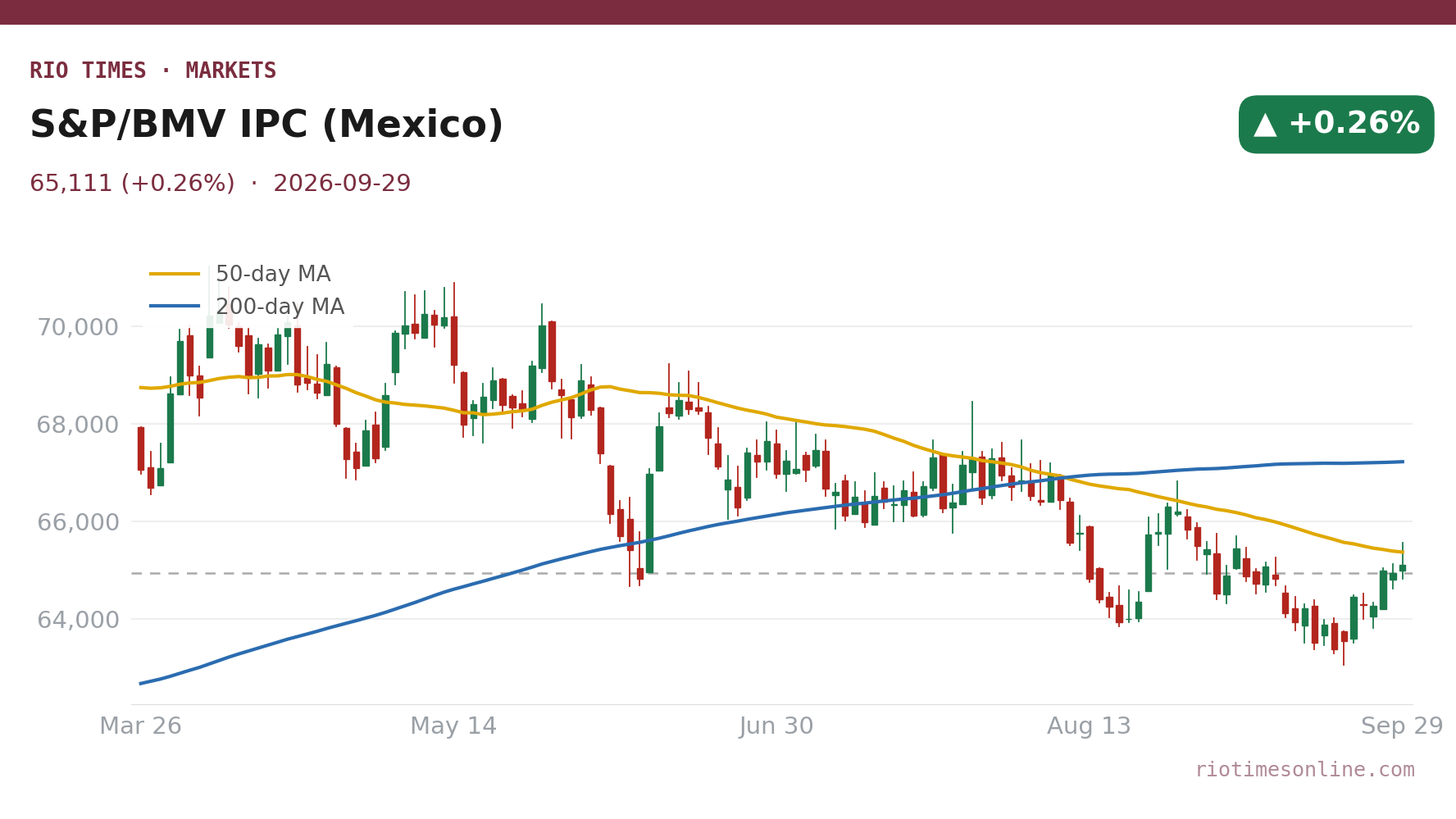
- Mexico’s main stock index, the S&P/BMV IPC, closed 0.26% higher at 65,110.57 points on Tuesday, 29 September, its highest close since 3 September, even as Wall Street fell
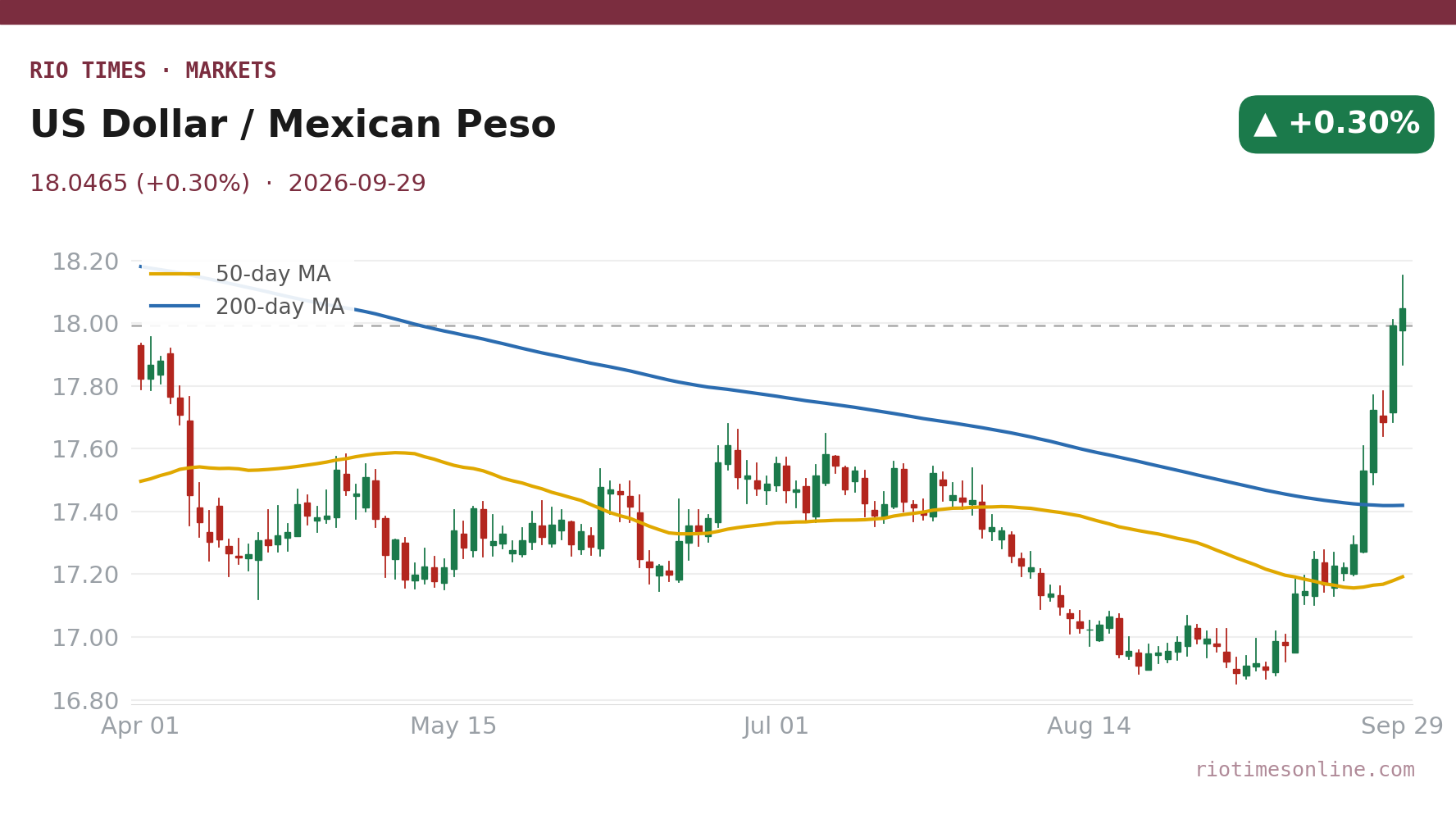
- The peso, Mexico’s currency, weakened 0.30% to 18.0465 per US dollar, its weakest close since 30 March and the first close above 18 since then
- Cemex, the cement giant, rose 1.9% and bottler and retailer Femsa 1.8%, leading the large caps; breadth was strong, with 514 issues up and 205 down
- US consumer confidence fell to 81.9 in September, far below the roughly 89 expected and the lowest since 2014, the main data point of Tuesday’s calendar; Mexico had no releases of its own
- The IPC remains about 9.1% below its 52-week closing high of 71,601 points from 11 February
Today’s Focus
Mexico’s S&P/BMV IPC, the main stock index that tracks the country’s largest listed companies, closed up 0.26% at 65,110.57 on Tuesday, 29 September. The advance was modest but broad: 514 issues rose, 205 fell and 25 were unchanged, according to the exchange data reported by EFE.
Cemex, the cement producer known as CEMEXCPO on the local exchange, gained 1.9% on about US$32 million of turnover. Femsa, the bottler and convenience-store operator trading as FEMSAUBD, rose 1.8% on about US$37 million.
The peso told a different story, slipping 0.30% to 18.0465 per US dollar, its weakest close since 30 March. A firmer dollar and US ten-year Treasury yields near 5.25% kept pressure on emerging-market currencies.
In the United States, the Conference Board’s consumer confidence index fell to 81.9 in September from 88.6 in August, well below forecasts and the lowest reading since 2014. Wall Street closed lower, with the S&P 500 down 0.17%.
What matters today. The IPC gained even as the peso closed above 18 and US stocks fell, showing local equities can still attract buyers when the currency wobbles.

01 The session in one read
Mexico’s stock market eked out a small gain on September 29, with the S&P/BMV IPC — the benchmark index of the Bolsa Mexicana de Valores, or Mexican stock exchange — closing up 0.26% at 65,110.57 points. The move was a quiet one, but buyers stepped in for select industrial and consumer names.
The day’s standout was Cemex, the Monterrey-based cement producer whose shares trade under the ticker CEMEXCPO. It climbed 1.9%, one of the best moves among the most heavily traded names. The day’s biggest gainers were smaller stocks such as chemicals group Cydsa, up 6.68%.
Femsa, the company behind OXXO convenience stores and Coca-Cola bottling across Latin America, rose 1.8% under its FEMSAUBD listing. Telecoms giant América Móvil — AMXB on the ticker — added 1.2% on about US$48 million of turnover.
But the currency market reminded everyone that the country’s macro picture is not entirely comfortable. The peso dipped 0.30% to 18.0465 per US dollar, its first close above 18 since 30 March.
The session showed a split: domestic-facing industrial and consumer stocks drew buyers, while the currency faced pressure from a firmer US dollar and high US bond yields. The 0.26% index gain, led by Cemex and Femsa, suggests investors still see value in select Mexican equities even as the macro backdrop stays tricky. Watch whether the peso’s move above 18 proves sticky — that could eventually cool enthusiasm for shares with heavy import costs.
02 The day’s numbers
| Measure | Level | Change | Read |
|---|---|---|---|
| S&P/BMV IPC | 65,110.57 | +0.26% | Highest close since 3 September; 9.1% below 52-week high |
| Session range | 64,817–65,565 | — | Intraday low and high |
| USD/MXN (peso) | 18.0465 | +0.30% | Peso weaker; weakest close since 30 March |
| 52-week high (close) | 71,601 | — | 11 February 2026 |
| 52-week low (close) | 60,216 | — | 7 October 2025 |
The index’s 0.26% rise left it at 65,110.57 points, about 9.1% below its 52-week closing high of 71,601. The index is up about 1.2% this year, from 64,308 points at the end of 2025, and down about 0.5% in September, from 65,430 at the end of August.
The peso’s move to 18.0465 per US dollar reflected pressure from abroad. The dollar index rose 0.17% and the US ten-year Treasury yield ended at 5.249%.
Live Market IntelligenceMexico — Live Market Board
Rio Times · Live Market Intelligence
Mexico — Live Market Board
| Instrument | Last | Change | YoY | Prev. | High | Low | Volume |
|---|---|---|---|---|---|---|---|
| IPC MEX | 65,110.57 | +0.26% | +12.17% | 64,944.41 | 66,121 | 65,405 | 108,886,187 |
| USD/MXN | 17.06 | -0.24% | -8.58% | 17.10 | 17.08 | 17.01 | — |
| WALMEX | 48.07 | -0.62% | -14.38% | 48.37 | 48.65 | 48.02 | 10,781,446 |
| GMEXICO | 223.28 | +0.35% | +73.59% | 222.50 | 226.18 | 222.17 | 1,325,556 |
| FEMSA | 201.19 | -0.24% | +25.67% | 201.67 | 206.71 | 199.56 | 750,706 |
| CEMEX | 19.32 | +0.89% | +19.10% | 19.15 | 19.35 | 19.04 | 14,327,054 |
| GFNORTE | 193.98 | +1.18% | +14.36% | 191.71 | 195.79 | 191.83 | 1,579,115 |
| BIMBO | 60.98 | -0.96% | +11.89% | 61.57 | 61.46 | 60.29 | 1,048,115 |
| TELEVISA | 9.71 | +0.21% | +12.78% | 9.69 | 9.75 | 9.60 | 577,851 |
| AMX | 19.80 | -0.95% | +12.53% | 19.99 | 20.05 | 19.70 | 58,058,525 |
| GAP | 366.23 | +0.43% | -21.21% | 364.68 | 370.85 | 362.82 | 226,946 |
| ASUR | 275.04 | +1.25% | -15.28% | 271.64 | 275.08 | 271.31 | 15,451 |
| OMA | 233.50 | +0.62% | -6.48% | 232.06 | 235.00 | 230.62 | 555,693 |
| KOF | 188.04 | +0.86% | +18.94% | 186.44 | 188.56 | 185.52 | 425,273 |
| GRUMA | 252.90 | +0.11% | -21.85% | 252.61 | 254.74 | 250.36 | 90,048 |
| KIMBER | 39.74 | +0.43% | +8.85% | 39.57 | 40.09 | 39.33 | 490,551 |
| AMX ADR | 23.38 | -0.23% | +22.25% | 23.43 | 23.49 | 23.06 | 1,347,445 |
03 Why it moved — local strength, global weight
The IPC’s small gain came from stock picking rather than a broad macro catalyst. Cemex’s 1.9% gain and Femsa’s 1.8% climb carried the index, and no major company announcement was reported.
At the same time, the peso’s weakness reflected global forces rather than a Mexico-specific shock. A firmer US dollar and US ten-year yields near 5.25% made emerging-market currencies such as the peso less attractive.
Gabriela Siller of Banco Base told EFE that global stock losses continued as higher Treasury yields offered better returns with less risk than equities. Mexican stocks held their ground anyway, while the currency bore the weight of global caution.
04 The day’s movers
| Driver | Level / Move | Change | Note |
|---|---|---|---|
| Cemex (CEMEXCPO) | 1.9% | +1.9% | Top gainer among most-traded names, US$32m turnover |
| Femsa (FEMSAUBD) | 1.8% | +1.8% | Retail and bottling strength, US$37m turnover |
| América Móvil (AMXB) | 1.2% | +1.2% | Telecoms leader, US$48m turnover |
| Banorte (GFNORTEO) | 0.5% | +0.5% | Banking heavyweight, US$68m turnover |
| Walmex (WALMEX) | −0.2% | −0.2% | Mexico’s Walmart unit dipped, US$32m turnover |
| Grupo México (GMEXICOB) | 0.0% | 0.0% | Flat despite heaviest turnover at US$105m |
| GAP (airports) | −1.1% | −1.1% | Airport operator lagged, US$29m turnover |
The movers table shows a market that rewarded industrial and consumer-facing companies while staying cautious on some infrastructure names. Airport operator GAP fell 1.1% on about US$29 million of turnover, the weakest of the names in the table.
Grupo México, the mining and rail conglomerate, finished flat even as it saw the heaviest trading among these names, at about US$105 million. That suggests investors were repositioning rather than making a strong directional bet on the stock.
05 The regional scoreboard
| Index | Country | Change |
|---|---|---|
| S&P/BMV IPC | Mexico | +0.26% |
| Ibovespa | Brazil | +0.46% |
| IPSA | Chile | −0.73% |
| Merval | Argentina | +0.00% |
| COLCAP | Colombia | −0.79% |
Mexico’s IPC and Brazil’s Ibovespa were the region’s gainers, while Chile, Argentina and Colombia finished lower. The mixed picture shows that Latin American markets are not moving as a single bloc right now.
Chile’s IPSA fell with copper, Argentina’s Merval posted an eighth straight loss, and Colombia’s COLCAP closed at 2,559 points.
06 The technical picture
The IPC’s close at 65,110.57 is its highest since 3 September and leaves it just above the round 65,000 mark. Tuesday’s intraday high of 65,565 is the next reference for buyers.
The peso’s break above 18.00 is a technical signal worth noting for currency traders. For most of September the pair closed between about 16.88 and 17.72. A run of closes above 18 would mark a clear shift from that range.
07 Tuesday’s data, one by one
Monday’s edition told readers to watch US-Iran talks, the peso near 18 per US dollar, US Treasury yields and local inflation readings. Mexico had no releases of its own on Tuesday’s calendar, so the day’s data came from the United States.
- US consumer confidence (Conference Board, September): 81.9, against about 89 expected and 88.6 in August (revised from 89.4). It was the lowest reading since 2014, a sign that US households are worried about prices and jobs. Wall Street fell and the dollar still firmed, so the peso got no relief.
- US job openings (JOLTS, August): 7.08 million, below the 7.23 million expected and down from a revised 7.34 million in July. Labour demand is cooling. The market reaction was limited.
- US house prices (July): the S&P/Case-Shiller 20-city index rose 2.5% year on year, above the 2.2% expected, and the FHFA index rose 0.3% on the month. No visible market impact.
- Fed speakers: New York Fed president John Williams said he saw no urgency for another rate increase after the September hike. The US ten-year yield ended almost unchanged at 5.249%, still high enough to weigh on the peso.
- US-Iran talks: no breakthrough was reported. Oil fell anyway, with Brent futures down about 2.6% to US$102.59 a barrel.
- Peso near 18: the level we flagged gave way at the close, with the peso ending at 18.0465 per US dollar.
- Local inflation readings: none were due on Tuesday. The next Mexican releases are business confidence, the S&P Global manufacturing PMI and the August fiscal balance on Thursday.
08 What to watch
- China PMIs (released overnight): the official NBS manufacturing PMI rose to 50.1 in September from 49.8, in line with forecasts, and the non-manufacturing PMI rose to 50.2, the last Chinese data before Golden Week
- US data (12.15–1.45 pm UTC): ADP private payrolls (about 70,000 expected after 38,000), August PCE prices and personal spending, the final second-quarter GDP estimate and the Chicago PMI
- Colombia rate decision: Banco de la República is expected to hold its policy rate at 12% on Wednesday afternoon
- Peso above 18: whether Mexico’s currency holds above 18 per US dollar after its weakest close since March
- Mexico on Thursday: business confidence, the manufacturing PMI and the August fiscal balance
Background: Mexico’s IPC Falls 0.78% as the Peso Slips Before Banxico.
Frequently Asked Questions
What is the S&P/BMV IPC?
It is Mexico’s main stock index, tracking the largest and most traded companies on the Bolsa Mexicana de Valores, the country’s stock exchange in Mexico City.
Why did the peso weaken past 18 per US dollar?
A firmer US dollar and US ten-year Treasury yields near 5.25% weighed on emerging-market currencies. The peso closed at 18.0465 per US dollar, its weakest close since 30 March.
Which Mexican stocks led the gains?
Cemex rose 1.9% and Femsa gained 1.8%, leading the large caps. Smaller stocks such as chemicals group Cydsa, up 6.68%, posted the day’s biggest gains.
How far is the IPC from its recent high?
The index closed at 65,110.57, about 9.1% below its 52-week closing high of 71,601 points from 11 February.
Source: RT live market data, close of Tuesday 29 September 2026; exchange figures from BMV.
This article was produced by The Rio Times’ automated newsroom system. How we use AI · Report an error
In depth
LatAm Markets: Live Signals → — real-time movers, turnover leaders and FX across Latin America.
Read More from The Rio Times