Oil Wrap: USO Hits US$129.17, Petrobras Rises, Ecopetrol Falls
Key Facts
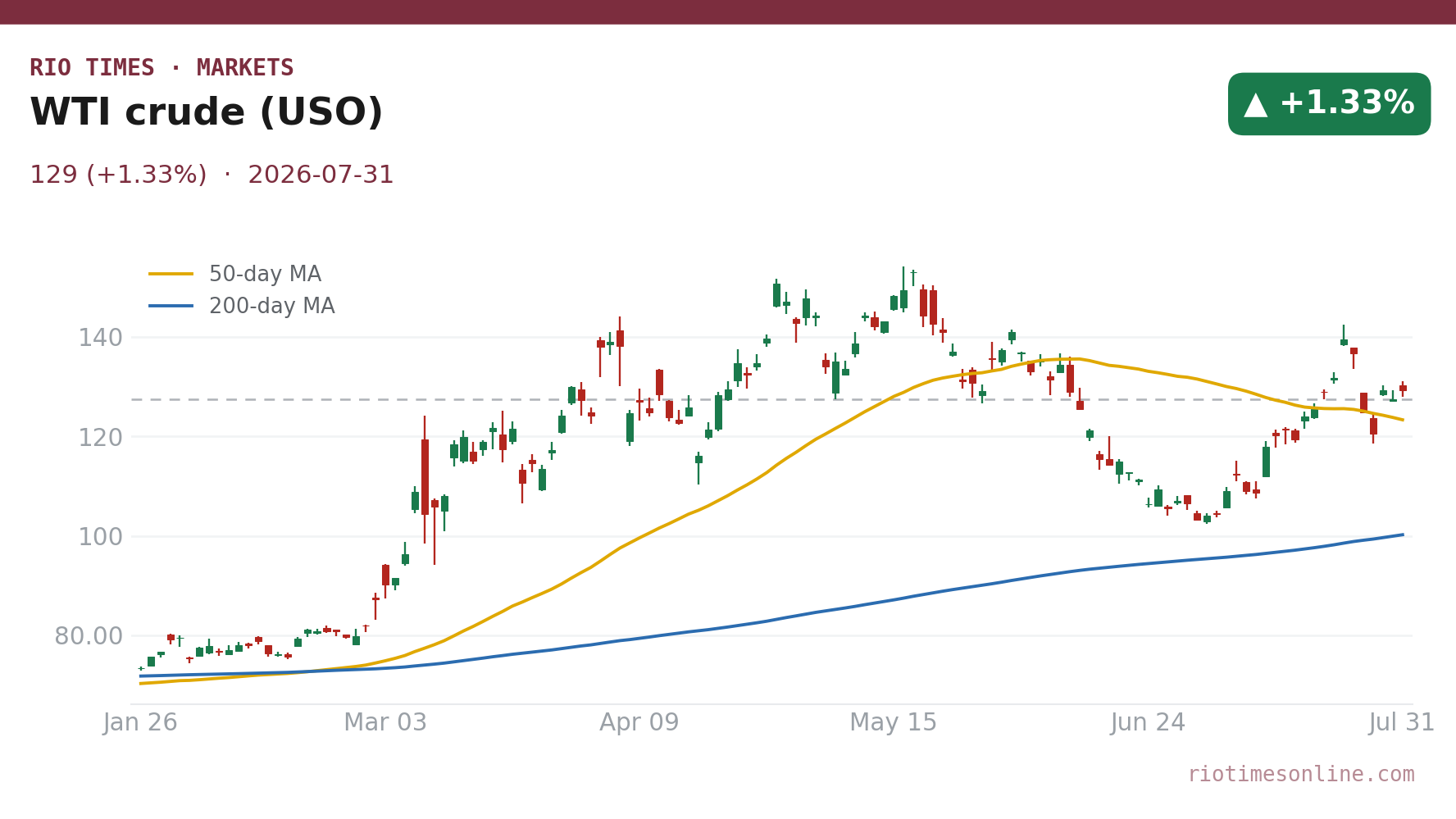
- WTI’s tracking fund USO closed at US$129.17, up 1.33% extending a rally driven by tighter supply expectations and persistent geopolitical risk in shipping lanes.
- Stronger crack spreads supported the move reflecting higher US Gulf Coast refinery margins that bolster integrated producers’ cash generation.
- Petrobras shares rose 1.46% to US$19.40 as firmer crude highlighted the appeal of Brazil’s low-cost, long-lived pre-salt barrels.
- Argentina’s YPF advanced 0.75% to US$52.54 tracking the oil price and an improved local backdrop, signalling cautious optimism for Vaca Muerta drilling.
- Colombia’s Ecopetrol dropped 1.58% to US$16.77 bucking the regional trend after chief executive Ricardo Roa left the company on 30 July amid an influence-peddling investigation, with an acting president taking charge on 31 July.
- Guyana’s offshore boom remained a focal point with higher WTI levels enhancing the economics of future floating production units in the Stabroek block.
Today’s Focus
Crude’s summer advance continued on Friday, with the US Oil Fund, the exchange-traded vehicle tracking WTI, settling at US$129.17 for a 1.33% daily gain. The move reflected a market pricing tighter physical supply, steady global demand, and lingering threats to shipping lanes.
Brazil’s state-controlled giant Petrobras rode the wave, its New York shares climbing 1.46% to US$19.40. Investors treated the stock as a liquid way to bet on high oil prices via the company’s prolific and comparatively cheap pre-salt deepwater fields.
Argentina’s YPF also participated, closing 0.75% higher at US$52.54, as the rally in crude strengthened the investment case for the Vaca Muerta shale formation despite the country’s chronic capital controls. Bucking the trend, Colombia’s Ecopetrol slid 1.58% to US$16.77, punished by a governance shock: Ricardo Roa left the chief executive post on 30 July under an influence-peddling charge, and on 31 July he approached prosecutors seeking a plea deal.
What matters today. Strong crude prices are a rising tide, but they cannot lift boats anchored by country-specific political and policy risks, as Ecopetrol’s drop made clear.
01 The session in one read
Latin America’s energy complex mostly climbed alongside global crude benchmarks on Friday, with the US Oil Fund closing at US$129.17 for a 1.33% advance — recovering the ground lost in the previous session, when USO slipped 1.42% to US$127.48. The rally stemmed from a market narrative focused on tightening supply and steady demand, amplified by geopolitical friction that threatens tanker routes.
Brazil’s Petrobras rose 1.46% to US$19.40 and Argentina’s YPF added 0.75% to US$52.54, directly benefiting from the stronger tape. The clear exception was Colombia’s Ecopetrol, which fell 1.58% to US$16.77 as a leadership vacuum at the top of the company overshadowed the commodity’s upward march.
The session painted a clear picture: higher WTI, as tracked by USO’s rise to US$129.17, acts as a powerful tailwind for well-managed, low-cost Latin American producers. Petrobras and YPF moved in lockstep with crude, while Guyana’s break-even economics look ever more attractive. The outlier, Ecopetrol’s 1.58% decline to US$16.77, shows that governance and regulatory uncertainty in Colombia is currently outweighing the benefit of a firmer crude tape. One caution on the numbers: US$129.17 is the price of a single USO share, not the price of a barrel of oil. The key variable to watch is any formal change to Colombia’s exploration licensing policy, which could deepen Ecopetrol’s disconnect from the crude tape.
02 The board
The US Oil Fund’s settlement at US$129.17, a gain of 1.33%, set the tone, acting as the session’s primary bullish signal for global investors. This filtered through directly to Brazil, where Petrobras shares hit US$19.40, up 1.46%.
Argentina’s YPF tracked the move with a 0.75% rise to US$52.54, while Colombia’s Ecopetrol diverged sharply, dropping 1.58% to US$16.77. The mixed board underscored how national stories are now heavily mediating what is otherwise a straightforward rally in the crude proxy. All three producer quotes above are the New York-listed American depositary receipts — PBR, EC and YPF — and not the local lines in São Paulo, Bogotá and Buenos Aires, which are priced in reais and pesos.
| Asset | Level | Change |
|---|---|---|
| WTI crude (USO) | US$129.17 | +1.33% |
| Petrobras | US$19.40 | +1.46% |
| Ecopetrol | US$16.77 | -1.58% |
| YPF | US$52.54 | +0.75% |
Source: RT close, 2026-07-31. Where a commodity has no spot feed, an exchange-traded tracker or leading producer is shown as a labelled proxy.
Live Market IntelligenceThe live market board
Rio Times · Live Market Intelligence
Latin America — Cross-Market Board
| Instrument | Last | Change | YoY | Prev. | High | Low | Volume |
|---|---|---|---|---|---|---|---|
| IBOV | 167,874.64 | -2.50% | +23.78% | 172,179.93 | — | — | — |
| IPSA | 11,128.56 | -1.25% | — | 11,268.86 | 11,308 | 11,064 | 1,513,213,483 |
| IPC MEX | 65,878.37 | -0.84% | +12.38% | 66,438.58 | 66,459 | 65,510 | 105,479,702 |
| MERVAL | 3,022,485 | -3.19% | +31.22% | 3,122,065 | 3,185,663 | 2,994,004 | — |
| COLCAP | 2,423.37 | +2.14% | — | 9.04 | 9.05 | 9.02 | 4,133 |
| BVL PERÚ | 59,693.55 | -1.60% | — | — | — | — | — |
| USD/BRL | 5.16 | +0.93% | -5.24% | 5.11 | 5.17 | 5.16 | — |
| EUR/BRL | 5.95 | +1.42% | -5.78% | 5.87 | 5.97 | 5.95 | — |
| USD/MXN | 17.06 | -0.44% | -8.51% | 17.14 | 17.08 | 17.06 | — |
| USD/CLP | 913.38 | -0.42% | -5.71% | 917.27 | 913.38 | 913.38 | — |
| USD/COP | 3,128 | -0.87% | -22.33% | 3,156 | 3,128 | 3,125 | — |
| USD/PEN | 3.38 | -0.02% | -4.25% | 3.38 | 3.38 | 3.38 | — |
| USD/ARS | 1,491 | -0.53% | +12.81% | 1,498 | 1,491 | 1,491 | — |
| USD/UYU | 40.23 | +1.56% | +1.72% | 39.61 | 40.23 | 40.23 | — |
| USD/PYG | 5,925 | +1.88% | -19.73% | 5,816 | 5,925 | 5,925 | — |
| USD/BOB | 11.72 | +0.37% | +73.22% | 11.68 | 11.72 | 11.72 | — |
| USD/DOP | 58.20 | +1.20% | -3.67% | 57.51 | 58.20 | 58.04 | — |
| USD/CRC | 447.79 | +1.51% | -9.33% | 441.12 | 447.79 | 447.79 | — |
03 What moved it
Stronger US Gulf Coast refinery margins and improved crack spreads—the profit difference between buying crude and selling refined fuel—provided fundamental support, boosting integrated producers. These margins signal healthy demand and efficient processing, which flowed directly into the US Oil Fund’s up-day.
Persistent geopolitical risk in key shipping lanes added a supply-security premium, while broader market expectations of constrained output kept a floor under prices. This combination of physical market tightness and logistical fear pushed the WTI proxy past US$129.
04 The Latin American read
Brazil’s pre-salt remains the region’s most direct beneficiary of a price surge. Foreign investors viewed Petrobras, with its vast, low-lifting-cost offshore fields, as a reliable ‘liquid beta’ to the WTI proxy, pushing its New York-listed ADR up 1.46% to US$19.40. The company has been leaning harder on exports, with shipments climbing even as China trimmed its Brazilian crude purchases.
In Argentina, YPF’s 0.75% rise to US$52.54 reflected cautious optimism that sustained high oil prices can underwrite the huge drilling requirements of the Vaca Muerta shale, with an improved local macro backdrop providing a secondary lift. Guyana’s offshore sector, led by ExxonMobil, saw its long-term economics brighten, with USO’s rally supporting the case for new multi-billion-dollar floating production units. ExxonMobil has meanwhile used AI screening to flag four fresh prospects in the Stabroek block.
05 The names to watch
Colombia’s Ecopetrol was the session’s stark warning, its shares sinking 1.58% to US$16.77. This was a clear instance of country risk overriding commodity momentum, and the proximate trigger was governance rather than geology: Roa left the presidency on 30 July alongside the board chair and two vice-presidents, and the following day he asked prosecutors for a plea deal over campaign-finance allegations tied to the 2022 Petro campaign. The freeze on signing new exploration contracts remains the slower-burning backdrop.
Mexico’s Pemex remains a credit story, where higher oil revenues from the rally improve short-term budget relief but fail to solve structural problems of ballooning debt and refining losses. In Venezuela, a potential policy shift is monitored as the sole catalyst that could reconnect its massive heavy-oil resources with global capital.
06 The outlook
The path for Latin America’s oil names will be a tug-of-war between a robust global pricing environment and homegrown political risks. The US Oil Fund’s US$129.17 print is a powerful accumulator of value for Petrobras and YPF, but for Ecopetrol and Pemex, it merely buys time against fiscal and regulatory headwinds. The same session saw the grains board finish lower, a reminder that the commodity tape was not moving as one.
07 What to watch
- Crack spreads and refinery margins: Watch to see if the strong product demand that lifted USO to US$129.17 holds, confirming cash generation for integrated producers like Petrobras.
- Colombia’s exploration policy: Any formal government announcement on new licensing could rapidly move Ecopetrol further, having already sent it down 1.58% to US$16.77.
- Vaca Muerta infrastructure: YPF’s modest 0.75% rise to US$52.54 could accelerate if new midstream capacity eases export bottlenecks, unlocking higher wellhead netbacks.
- Guyana FPSO sanctioning: With WTI elevated, a green light for the next ExxonMobil-led floating production unit would cement the country’s status as a non-OPEC supply powerhouse.
Background: Braskem Bond Tender Rejected Amid US$9.4B Debt Crisis.
Frequently Asked Questions
Why did Ecopetrol fall when Petrobras and YPF rose on 31 July 2026?
Ecopetrol dropped 1.58% to US$16.77 on a governance shock rather than the oil price. Chief executive Ricardo Roa left on 30 July under an influence-peddling charge, together with the board chair and two vice-presidents. An acting president took over on 31 July, the same day Roa approached prosecutors about a plea deal.
Does USO at US$129.17 mean oil costs US$129 a barrel?
No. USO is the United States Oil Fund, an exchange-traded fund that holds WTI futures contracts, and US$129.17 is the price of one fund share. A barrel of West Texas Intermediate traded far below that level. The fund tracks the direction of WTI rather than its absolute price, because roll costs push the two apart over time.
Are the Petrobras, Ecopetrol and YPF prices quoted here local shares?
No, they are the New York-listed American depositary receipts, quoted in US dollars: PBR for Petrobras, EC for Ecopetrol and YPF for the Argentine producer. Their local lines trade in reais in São Paulo, in pesos on the Colombian exchange and in pesos in Buenos Aires, so percentage moves can differ once currency shifts.
What lifted crude on 31 July 2026?
The US Oil Fund rose 1.33% to US$129.17, recovering the 1.42% it lost the day before. Traders pointed to firmer US Gulf Coast refining margins, expectations of constrained supply and a security premium attached to tanker routes. No single confirmed headline drove the move, so it is best read as a broad repricing rather than one event.
Sources: Ecopetrol, United States Commodity Funds, Fiscalía General de la Nación
This article was produced by The Rio Times’ automated newsroom system. How we use AI · Report an error
LatAm Markets: Live Signals → — real-time movers, turnover leaders and FX across Latin America.
Read More from The Rio Times