Oil Slumps: Latin America Producers Hit as Iran Risk Premium Drains
Key Facts
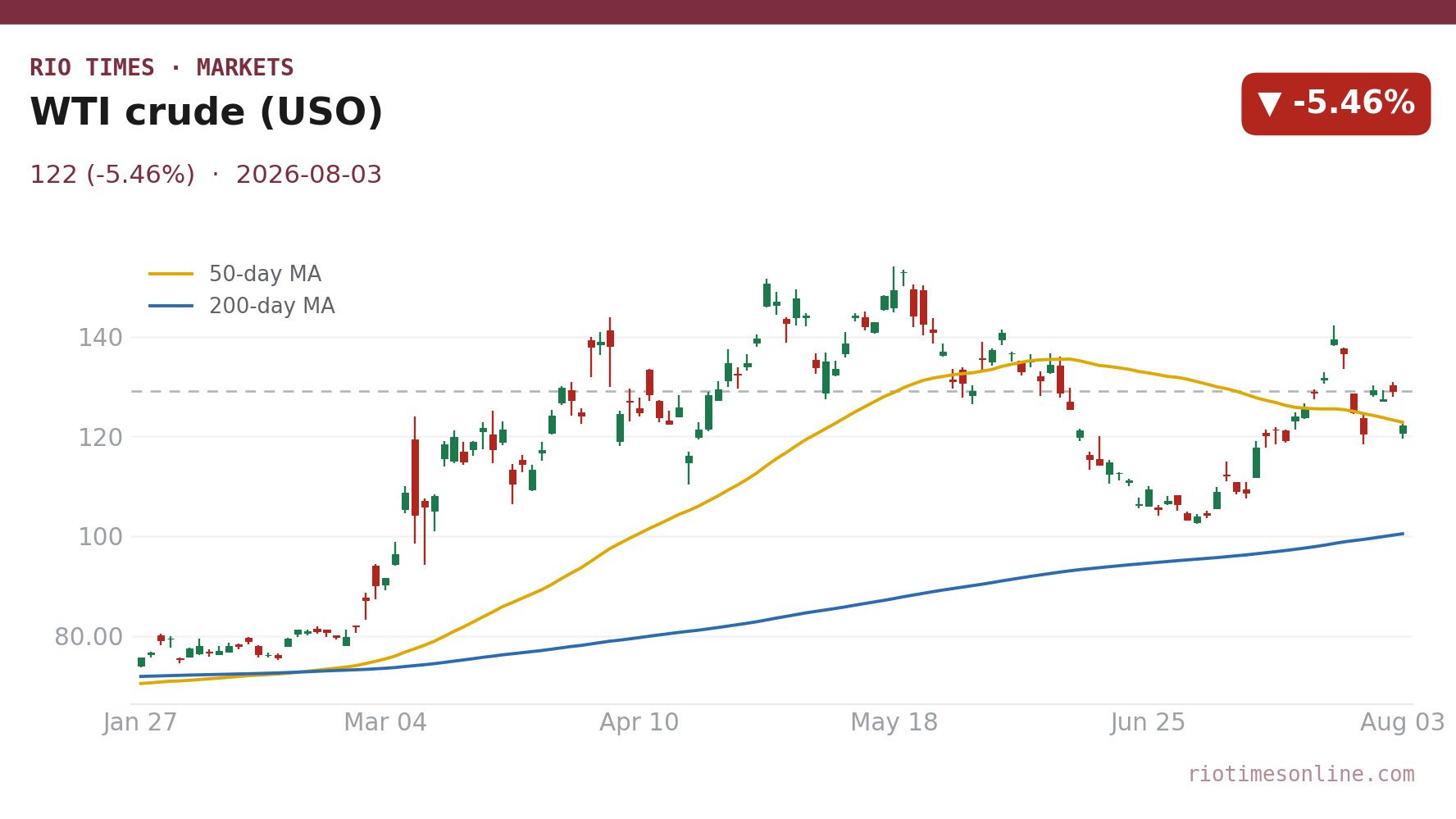
- The WTI crude proxy USO fell 5.46% to US$122.12, signalling a sharp single-session break lower for the US benchmark grade.
- Argentina’s YPF bore the heaviest blow among regional producers, closing down 2.82% at US$51.06 as traders repriced Vaca Muerta netbacks against a cheaper barrel.
- Brazil’s Petrobras slipped 1.75% to US$19.06, a move that cuts across both its pre-salt efficiency narrative and its colossal investment budget.
- Colombia’s Ecopetrol held relatively firm at US$16.60, down 1.01% and displaying more insulation than its South American peers.
- The trigger was geopolitical de-risking, not weak demand. President Donald Trump said he had called off a planned strike on Iran and pointed to talks that would cover the reopening of the Strait of Hormuz, draining the war premium out of crude.
- Wall Street closed at a record high in the same session and gold gave ground as the safety bid unwound, the signature of a supply-risk repricing rather than a growth scare.
- Guyana’s breakneck expansion and Mexico’s Pemex troubles stayed secondary storylines, as one headline out of Washington governed regional equity trading in the sector.
Today’s Focus
Every major Latin American oil equity retreated on Monday. The WTI-tracking United States Oil Fund, a listed proxy for near-month Nymex light sweet crude futures, sank 5.46% to close at US$122.12. That abrupt move dragged the entire regional roster into the red.
Argentina’s YPF led the losses, dropping 2.82% to US$51.06. Brazil’s state-controlled giant Petrobras fell 1.75% to US$19.06. Colombia’s Ecopetrol, though still negative, showed relative strength, declining only 1.01% to US$16.60.
The declines were not triggered by Latin American operational news, and they were not a verdict on demand. President Donald Trump said he had called off a planned strike on Iran after appeals from Gulf capitals, and signalled that any resulting agreement would cover the reopening of the Strait of Hormuz. Brent settled near US$84 a barrel and WTI near US$80, each down roughly 5%, as the war premium accumulated over previous weeks came out of the price. That single geopolitical shift overrode the region’s own supply stories, from Guyana’s Stabroek Block ramp-up to Mexico’s Pemex debt spiral.
For an outsider reading the Rio Times, the session underlined a truth about Latin American oil names: they are torque on WTI, no matter how compelling the local geology. When the crude proxy on US screens drops more than 5%, even the lowest-cost pre-salt barrel cannot hold its paper value flat.
What matters today. A collapsing war premium erased more value from Latin oil equities than any local operational setback could, and it did so on a day when US stocks closed at a record, proof that this was a supply-risk unwind rather than a demand scare.

01 The session in one read
Latin American oil equities were swept lower on Monday by a single-session rout in the WTI crude proxy. The United States Oil Fund (USO) closed down 5.46% at US$122.12, reflecting a heavy drop in the front-month West Texas Intermediate contract it tracks. The move left no regional name unscathed, reversing the gains Petrobras and YPF posted in the previous session.
Argentina’s YPF registered the deepest cut, falling 2.82% to end at US$51.06. Petrobras, the region’s largest producer by far, shed 1.75% to US$19.06. Colombia’s Ecopetrol proved the most resilient but still could not avoid a loss, retreating 1.01% to US$16.60. The declines were fast, globally synchronised, and entirely disconnected from the operational progress each company has reported in recent weeks.
Monday was a supply-side repricing, not a demand-side bludgeoning. Once the threat of a US strike on Iran was lifted and the reopening of the Strait of Hormuz moved into play, the geopolitical insurance embedded in every barrel was marked down at once, and Petróleo Brasileiro S.A., YPF Sociedad Anónima and Ecopetrol S.A. were revalued as leveraged claims on a cheaper crude curve. The tell sits elsewhere on the same tape: US equities closed at a record high and gold slipped as the safety bid drained away. A genuine growth scare does not produce record stock prices. The distinction matters for these producers, because crude falling on restored supply security compresses realised prices without the collapse in volumes a recession would bring. The critical variable to monitor next is whether USO can hold the US$120 psychological handle into the Tuesday session; another break below that could trigger fresh stop-loss selling across the NYSE-traded Latin American complex.
02 The board
A sweep across the proxy board tells a single story. The 5.46% plunge in the USO set the tone before a single local market opened, and the Latin American tickers simply marked time to the screen. New York-traded YPF bore the brunt of that mechanical repricing, its 2.82% slump to US$51.06 making it the session’s sharpest regional decliner.
Petrobras at US$19.06 and Ecopetrol at US$16.60 fell less severely, a reflection of their differing cost profiles and float characteristics rather than any corporate-specific news. But the direction was uniform: every dollar-denominated Latin oil equity that foreign investors can easily access ended the day materially lower. No countertrend buoyed a single name.
| Asset | Level | Change |
|---|---|---|
| WTI crude (USO) | US$122.12 | -5.46% |
| Petrobras | US$19.06 | -1.75% |
| Ecopetrol | US$16.60 | -1.01% |
| YPF | US$51.06 | -2.82% |
Source: RT close, 2026-08-03. Where a commodity has no spot feed, an exchange-traded tracker or leading producer is shown as a labelled proxy.
Live Market IntelligenceThe live market board
Rio Times · Live Market Intelligence
Latin America — Cross-Market Board
| Instrument | Last | Change | YoY | Prev. | High | Low | Volume |
|---|---|---|---|---|---|---|---|
| IBOV | 167,874.64 | -2.50% | +23.78% | 172,179.93 | — | — | — |
| IPSA | 11,128.56 | -1.25% | — | 11,268.86 | 11,308 | 11,064 | 1,513,213,483 |
| IPC MEX | 65,878.37 | -0.84% | +12.38% | 66,438.58 | 66,459 | 65,510 | 105,479,702 |
| MERVAL | 3,022,485 | -3.19% | +31.22% | 3,122,065 | 3,185,663 | 2,994,004 | — |
| COLCAP | 2,423.37 | +2.14% | — | 9.04 | 9.05 | 9.02 | 4,133 |
| BVL PERÚ | 59,693.55 | -1.60% | — | — | — | — | — |
| USD/BRL | 5.16 | +0.93% | -5.24% | 5.11 | 5.17 | 5.16 | — |
| EUR/BRL | 5.95 | +1.42% | -5.78% | 5.87 | 5.97 | 5.95 | — |
| USD/MXN | 17.06 | -0.44% | -8.51% | 17.14 | 17.08 | 17.06 | — |
| USD/CLP | 913.38 | -0.42% | -5.71% | 917.27 | 913.38 | 913.38 | — |
| USD/COP | 3,128 | -0.87% | -22.33% | 3,156 | 3,128 | 3,125 | — |
| USD/PEN | 3.38 | -0.02% | -4.25% | 3.38 | 3.38 | 3.38 | — |
| USD/ARS | 1,491 | -0.53% | +12.81% | 1,498 | 1,491 | 1,491 | — |
| USD/UYU | 40.23 | +1.56% | +1.72% | 39.61 | 40.23 | 40.23 | — |
| USD/PYG | 5,925 | +1.88% | -19.73% | 5,816 | 5,925 | 5,925 | — |
| USD/BOB | 11.72 | +0.37% | +73.22% | 11.68 | 11.72 | 11.72 | — |
| USD/DOP | 58.20 | +1.20% | -3.67% | 57.51 | 58.20 | 58.04 | — |
| USD/CRC | 447.79 | +1.51% | -9.33% | 441.12 | 447.79 | 447.79 | — |
Live Company IntelligenceYPF Sociedad Anonima — the full investor dossier
Wall Street view
Valuation & profitability
Price & risk
$22.8252-wk high
$57.49
Revenue trend · 6y
Ownership
Dividend
03 What moved it
A geopolitical de-escalation, not an economic downturn, was the proximate cause of Monday’s WTI slide. Trump said he had called off a planned strike on Iran at the request of Gulf states, and framed any subsequent deal as covering the reopening of the Strait of Hormuz, the chokepoint through which roughly a fifth of the world’s seaborne crude moves. Iran’s foreign ministry disputed that direct negotiations with Washington were under way but confirmed that discussions with Oman over management of the strait were in their final stages. Both versions pointed the market the same way: the supply disruption traders had been paying to insure against was receding.
The USO magnified the move, as the fund’s liquid structure lets macro hedge funds cut energy exposure within seconds. What it did not signal was distress. US equities closed at a record on the same tape and gold slipped as the safety bid drained, the exact pattern of a deflating war premium and the opposite of a demand shock. Latin American producers were caught on the wrong side of good news: the risk that had been inflating their revenue line simply went away.
This was not a day when traders weighed the intricacies of Brazilian pre-salt lifting costs or political noise in Brasília, even with the country having just posted record June output of 4.5 million barrels a day. It was a day when one headline out of Washington reset the risk premium in every barrel, and Latin American stocks were marked down in its wake, with YPF’s deeper decline reflecting its tighter liquidity and higher historical beta to WTI swings.
04 The Latin American read
Brazil’s pre-salt basins, which pump at costs far below current WTI levels, offered no protection for Petrobras shares. The stock’s 1.75% decline to US$19.06 occurred even as the company’s deepwater platforms continued to set internal production records this quarter. For international shareholders, the financial gravity of a US$122.12 crude proxy outweighed the engineering triumph happening 200 kilometres offshore.
In Argentina, YPF’s 2.82% fall to US$51.06 underlined Vaca Muerta’s frustrating paradox. The shale play is delivering some of the most compelling well productivity improvements outside the Permian, yet its associated equity cannot escape WTI’s shadow, and not even the cyberattack on Oldelval’s main crude trunk line registered against the scale of the geopolitical move. Meanwhile Guyana, where the Errea Wittu FPSO is set to push output past one million barrels a day, and Mexico, where Pemex continues to wrestle with unsustainable debt, remained subplots. Venezuela’s entrenched production crisis did not register either, on a day defined entirely by a single sell signal out of Washington.
05 The names to watch
Petrobras (US$19.06) remains the bellwether. Its ability to decouple from small daily crude moves has historically rested on its enormous cash dividend yield, but a 5.46% single-day hammering in the USO (US$122.12) overwhelms income strategies. Foreign investors will now scrutinise whether the Brazilian government, as controlling shareholder, signals any slowdown in the payout schedule if WTI keeps sliding.
YPF (US$51.06) demands particular attention after its outsized 2.82% drop. The Argentine operator is in the midst of a delicate pipeline capacity expansion to move Vaca Muerta gas and oil to global markets; a sustained pullback in crude threatens the internal rate of return on those capital commitments. Ecopetrol (US$16.60), down 1.01%, looks like the session’s relative safe harbour purely because its drop was less severe, and its gas exploration with Petrobras, including the Sandía-1 discovery off Colombia’s coast, does nothing to loosen its correlation to the USO.
06 The outlook
The immediate path for Latin American oil equities depends less on rig counts or fiscal terms than on whether the USO finds a floor near US$120. A stabilisation would allow fundamental stories to resurface: Petrobras’ pre-salt cash generation, YPF’s infrastructure catalysts, Guyana’s ramp beyond one million barrels per day. The swing factor is the Iran file itself. If the Hormuz talks progress, the premium that came out on Monday stays out, and traders will look to Organisation of the Petroleum Exporting Countries commentary as the only remaining circuit-breaker. If the talks stall or Washington revives the strike threat, that premium can go straight back into the price. With supply security improving for now, a holding period of lower crude and lower regional equity prices is the base case.
07 What to watch
- USO holding US$120: A further break below US$120 in the oil fund would likely trigger a second wave of selling across YPF and Petrobras, regardless of fundamentals.
- The Hormuz talks: Progress on reopening the strait keeps the war premium out of crude. A breakdown, or a revived US strike threat, would put it back in and lift Latin American producers with it.
- Guyana’s Stabroek fiscal terms: The ring-fencing dispute over Stabroek costs, estimated at US$12.4 billion, and the commissioning timetable for new FPSOs are the genuine supply-side variables in Georgetown.
- Petrobras dividend chatter: Any signal from Brasília on sustaining the extraordinary payout will test whether the stock can attract buyers even if WTI remains under pressure.
- Vaca Muerta midstream deadlines: YPF’s pipeline progress is the main idiosyncratic catalyst that could allow the stock to partially decouple if crude merely stabilises.
Frequently Asked Questions
Why did Latin American oil stocks fall on Monday 3 August 2026?
They tracked crude lower. The WTI proxy USO fell 5.46% to US$122.12 after President Donald Trump said he had called off a planned strike on Iran and pointed to talks covering the reopening of the Strait of Hormuz. That drained the war premium out of oil, and Petrobras, YPF and Ecopetrol were repriced against a cheaper barrel.
Was the selloff caused by a global growth scare?
No. On the same session US equities closed at a record high and gold slipped as the safety bid unwound. A genuine demand scare does not coexist with record stock prices. Monday was a supply-side repricing: the geopolitical insurance embedded in every barrel was marked down once the threat of a strike on Iran was lifted.
Which company fell the most and why?
Argentina’s YPF fell furthest, down 2.82% to US$51.06. Its New York listing is thinner than that of Petrobras and it carries a higher historical beta to WTI swings, so a 5.46% move in the crude proxy hits it harder. Nothing changed operationally at Vaca Muerta that day; the move repriced the barrel, not the business.
What should an international investor watch next?
Two things. First, whether the USO crude fund holds the US$120 level into the Tuesday session, since a break below could prolong selling across the Latin American energy complex. Second, the Hormuz talks: if they stall or Washington revives the strike threat, the war premium that came out on Monday can return just as quickly.
Sources: CNBC, Bloomberg, The National. Closing equity and fund levels from RT for 2026-08-03.
This article was produced by The Rio Times’ automated newsroom system. How we use AI · Report an error
LatAm Markets: Live Signals → — real-time movers, turnover leaders and FX across Latin America.
Read More from The Rio Times