Key Facts
- CSN fell sharply the New York-traded shares dropped 3.17% to US$1.22 in Friday’s session.
- Gerdau edged higher the US-listed stock rose 0.40% to US$4.97 on September 4, 2026.
- Ternium was almost flat the Mexican producer’s US shares inched up 0.03% to US$58.00.
- Brazil’s tariff shield holds a 25% tariff on 23 steel products above quota runs through June 2027.
- Mexico’s wall is higher tariffs of up to 50% cover 1,463 tariff lines from countries without free-trade deals.
- Demand is mixed but real Ternium cites a World Steel forecast of about 4% Mexican steel consumption growth in 2026, with Mexican auto output roughly flat.
Today’s Focus
Latin American steel shares told a split story on Friday, September 4, 2026. Brazil’s CSN led the downside, while Gerdau and Mexico’s Ternium held firmer ground.
The session was defined by how each name sits relative to cheap Chinese imports. CSN’s 3.17% slide to US$1.22 stood out against Gerdau’s 0.40% gain to US$4.97.
Tariff barriers remain the key defence. Brazil has kept a 25% tariff on 23 steel products above quota through June 2027, plus five-year anti-dumping duties on several Chinese flat steel items.
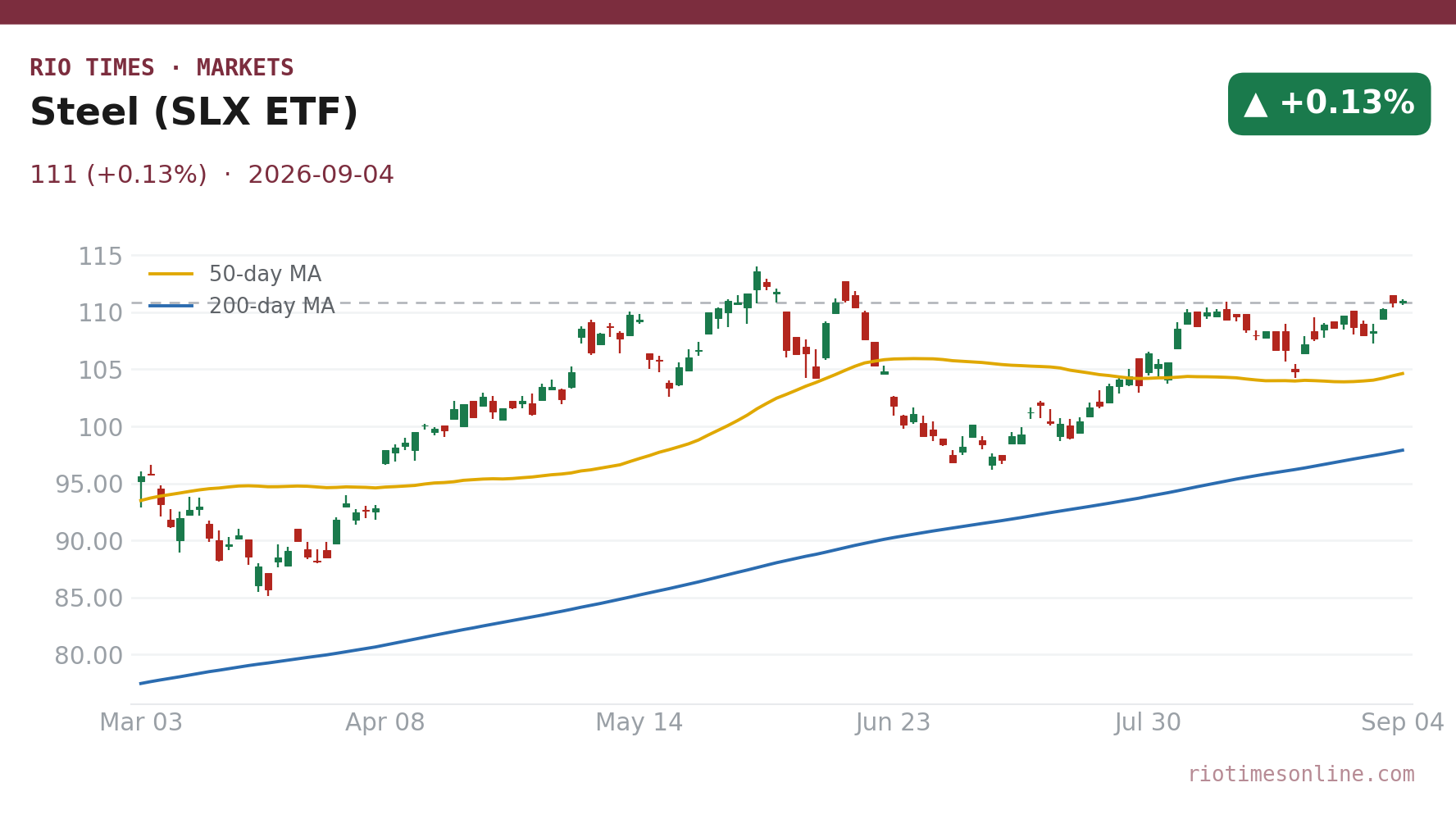
Ternium closed at US$58.00, barely changed, while the SLX steel-producers ETF rose 0.13% to US$110.99.
What matters today. The trade shield is working for most Latin American mills, and CSN’s fall was a pullback from a three-day rally rather than a break with the tariff-protected group.
01 The session in one read
Latin American steel shares diverged on Friday, September 4, 2026. Brazil’s CSN was the clear laggard, while Gerdau and Mexico’s Ternium showed more resilience.
The New York-traded CSN shares dropped 3.17% to US$1.22, a sharp move for a single session. Gerdau’s US-listed stock rose 0.40% to US$4.97, and Ternium added just 0.03% to US$58.00.
The broader SLX steel-producers ETF gave a modest positive read, up 0.13% to US$110.99. That suggests Friday was not a sector-wide sell-off, but rather a CSN-specific stumble.
CSN’s 3.17% drop to US$1.22 gave back part of a three-day run that had lifted the shares from US$1.13. Even with Brazil’s 25% tariff and anti-dumping duties shielding domestic flat steel, investors trimmed CSN while rewarding Gerdau’s long-steel exposure to construction demand. Ternium’s flat close at US$58.00 suggests the Mexican story of 50% tariffs and 4% consumption growth is priced in but not yet exciting. The variable to watch is whether Chinese export prices fall further, testing whether the tariff walls hold or simply delay the pain for Brazilian and Mexican mills.
02 The board
The price board showed a quiet session for the sector overall. The SLX ETF’s 0.13% rise to US$110.99 was the calmest signal available to foreign investors tracking steel equities.
Gerdau’s 0.40% gain to US$4.97 kept the Brazilian long-steel producer in positive territory. Ternium’s US$58.00 close, up just 0.03%, reflected a Mexican name treading water.
CSN’s US$1.22 close, down 3.17%, was the outlier. That drop stood in contrast to the other names on the board and hinted at company-specific or flat-steel-specific pressure rather than a regional macro shock.
| Asset | Level | Change |
|---|---|---|
| Steel (SLX ETF) | US$110.99 | +0.13% |
| Gerdau | US$4.97 | +0.40% |
| CSN (ADR) | US$1.22 | -3.17% |
| Ternium | US$58.00 | +0.03% |
Source: RT close, 2026-09-04. Where a commodity has no spot feed, an exchange-traded tracker or leading producer is shown as a labelled proxy.
Live Market IntelligenceThe live market board
Rio Times · Live Market Intelligence
Latin America — Cross-Market Board
| Instrument | Last | Change | YoY | Prev. | High | Low | Volume |
|---|---|---|---|---|---|---|---|
| IBOV | 185,147.15 | -0.02% | +21.85% | 185,188.13 | 168,310 | 167,142 | — |
| IPSA | 11,315.26 | -1.14% | — | 11,445.90 | 11,210 | 10,984 | 1,513,213,483 |
| IPC MEX | 64,727.54 | -0.21% | +12.17% | 64,866.61 | 66,121 | 65,405 | 108,886,187 |
| MERVAL | 3,034,599 | +1.11% | +30.51% | 3,022,485 | 3,042,365 | 2,991,150 | — |
| COLCAP | 2,565.50 | +0.82% | — | 9.04 | 9.05 | 9.02 | 4,133 |
| BVL PERÚ | 59,789.81 | — | — | — | — | — | — |
| USD/BRL | 5.16 | +0.01% | -5.13% | 5.16 | 5.18 | 5.14 | — |
| EUR/BRL | 5.95 | +1.01% | -5.83% | 5.89 | 5.98 | 5.94 | — |
| USD/MXN | 17.06 | -0.24% | -8.58% | 17.10 | 17.08 | 17.01 | — |
| USD/CLP | 913.98 | +0.04% | -5.67% | 913.65 | 915.11 | 906.68 | — |
| USD/COP | 3,140 | +0.03% | -22.04% | 3,139 | 3,141 | 3,105 | — |
| USD/PEN | 3.36 | -0.66% | -4.82% | 3.38 | 3.38 | 3.35 | — |
| USD/ARS | 1,493 | +0.10% | +12.96% | 1,491 | 1,494 | 1,480 | — |
| USD/UYU | 40.27 | +1.24% | +1.80% | 39.77 | 40.27 | 40.23 | — |
| USD/PYG | 5,939 | +1.68% | -19.54% | 5,841 | 5,939 | 5,925 | — |
| USD/BOB | 11.64 | -0.76% | +72.04% | 11.73 | 11.72 | 11.64 | — |
| USD/DOP | 58.34 | +1.25% | -3.44% | 57.62 | 58.34 | 58.04 | — |
| USD/CRC | 445.92 | +0.89% | -9.71% | 441.97 | 448.50 | 445.92 | — |
Live Company IntelligenceGerdau S.A — the full investor dossier
Valuation & profitability
Price & risk
$15.7852-wk high
$26.44
Revenue trend · 6y
Ownership
Dividend
03 What moved it
Cheap Chinese steel remains the main competitive threat facing Latin American mills. Tariff barriers are the primary defence, and Friday’s moves showed investors weighing how well each producer is shielded.
Brazil has kept a 25% tariff on imports of 23 steel products above quota through June 2027. It also retains five-year anti-dumping duties on Chinese cold-rolled, hot-dip galvanised and pre-painted flat steel.
Mexico’s wall is even higher. Tariffs of 5% to 50% apply to 1,463 tariff lines from countries without a free-trade deal, including steel, a permanent regime that replaced the temporary decrees running since August 2023.
Demand drivers split by product and country. Construction demand supports Brazilian long steel, helping Gerdau. Ternium cites a World Steel forecast of about 4% Mexican steel consumption growth in 2026, while Mexican auto output stays roughly flat near 4 million units.
New York and Sao Paulo were closed on Monday, September 7, for Labour Day and Brazilian Independence Day, but Shanghai traded. Rebar futures eased 23 yuan to 3,108 yuan per tonne, a fall of 0.73%.
Chinese steel exports rose 7.8% week-on-week to 2.55 million tonnes, an eight-week high, while Tangshan mills averaged losses of more than 100 yuan per tonne on rising raw-material costs. That combination, weak margins and heavy export volumes, is what the tariff walls in Brazil and Mexico are built against.
04 The Latin American read
For foreign investors, the key question is whether tariff walls can keep Chinese steel at bay. Brazil’s protection helps Gerdau, CSN and Usiminas by limiting cheap imports in the local market.
Mexico’s tariff regime supports Ternium by curbing non-FTA imports and backing local supply chains. The 50% ceiling on goods from countries without a free-trade deal is among the region’s most aggressive.
Yet CSN’s drop to US$1.22 on Friday shows that tariffs alone do not guarantee share-price strength. The flat-steel producer faces pressure even with anti-dumping duties in place.
The session’s split between Gerdau’s strength and CSN’s weakness points to a market distinguishing between long-steel demand from construction and flat-steel exposure to global overcapacity.
05 The names to watch
Gerdau’s US-listed shares rose 0.40% to US$4.97, the strongest relative move among the named Latin American producers. Its exposure to Brazilian construction demand gives it a domestic cushion.
CSN’s New York shares fell 3.17% to US$1.22, giving back part of a three-day run that had lifted them from US$1.13, including a 7.69% jump on heavy volume on Thursday.
Ternium closed at US$58.00, barely changed. The roughly 4% expected Mexican consumption growth in 2026 offers a steady backdrop, but with auto output flat the market wanted no more Friday.
Usiminas figures were not available for the Friday session, but the company remains protected by Brazil’s same 25% tariff and anti-dumping regime that shields Gerdau and CSN.
06 The outlook
The near-term outlook hinges on whether Chinese export prices stay low enough to test the tariff walls. If they do, Latin American mills may need to lean harder on domestic demand.
Brazilian construction and Mexican steel consumption remain the clearest demand supports. Ternium’s 6% auto output growth call for 2026 applies to Brazil, not Mexico, where production is flat.
For Brazil, the 25% tariff through June 2027 gives mills a long runway. But CSN’s Friday slide to US$1.22 is a reminder that investors want evidence the protection translates into earnings, not just survival.
The SLX ETF’s 0.13% rise to US$110.99 suggests no regional panic yet. The next test is whether Gerdau’s long-steel strength and Ternium’s stability can offset any further weakness in flat steel.
07 What to watch
- Chinese export prices: Any further fall in Chinese steel prices would test whether Brazil’s 25% tariff and Mexico’s 50% tariff genuinely hold back imports or merely delay the pressure.
- CSN earnings signals: After Friday’s 3.17% drop to US$1.22, any company-specific news on costs, volumes or flat-steel pricing could drive the next leg for Brazil’s most volatile steel share.
- Mexican auto output: Ternium sees Mexican auto production flat near 4 million units in 2026, with its 6% growth call applying to Brazil. Monthly Mexican auto data will test that view.
- Brazilian construction activity: Long-steel demand from construction underpins Gerdau’s resilience. Cement and construction employment data offer early reads on whether that support is holding.
Frequently Asked Questions
Why did CSN fall while Gerdau rose?
CSN’s New York shares dropped 3.17% to US$1.22, while Gerdau rose 0.40% to US$4.97. The split reflects stronger construction demand for Gerdau’s long steel versus pressure on CSN’s flat-steel exposure.
What is protecting Latin American steel from Chinese imports?
Brazil has a 25% tariff on 23 steel products above quota through June 2027 plus anti-dumping duties on Chinese cold-rolled, galvanised and pre-painted flat steel. Mexico applies tariffs of 5% to 50% on 1,463 tariff lines from countries without free-trade deals.
What does the SLX ETF tell us about Friday’s session?
The SLX steel-producers ETF rose 0.13% to US$110.99. The small gain suggests the sector was broadly steady, with CSN’s 3.17% drop being a company-specific move rather than a regional sell-off.
What are the main demand drivers for Latin American steel?
In Brazil, construction demand supports long-steel producers like Gerdau, with auto output seen up 6%. In Mexico, steel consumption is forecast to grow about 4% in 2026.
Market data: RT
This article was produced by The Rio Times’ automated newsroom system. How we use AI · Report an error
LatAm Markets: Live Signals → — real-time movers, turnover leaders and FX across Latin America.
Read More from The Rio Times