Uruguay AI Lab With Microsoft Builds 8 State Projects

TECHNOLOGY · URUGUAY
Key Facts
- —The country Uruguay, a small and stable South American democracy between Brazil and Argentina, wants to become a regional hub for artificial intelligence.
- —Why it matters US tech giant Microsoft supplies the engineering for a government lab that builds AI tools for Uruguay’s public bodies, from registries to the state power utility.
- —Why now The partners presented the first results on Monday 5 October in Montevideo, six months after the lab opened on 11 March.
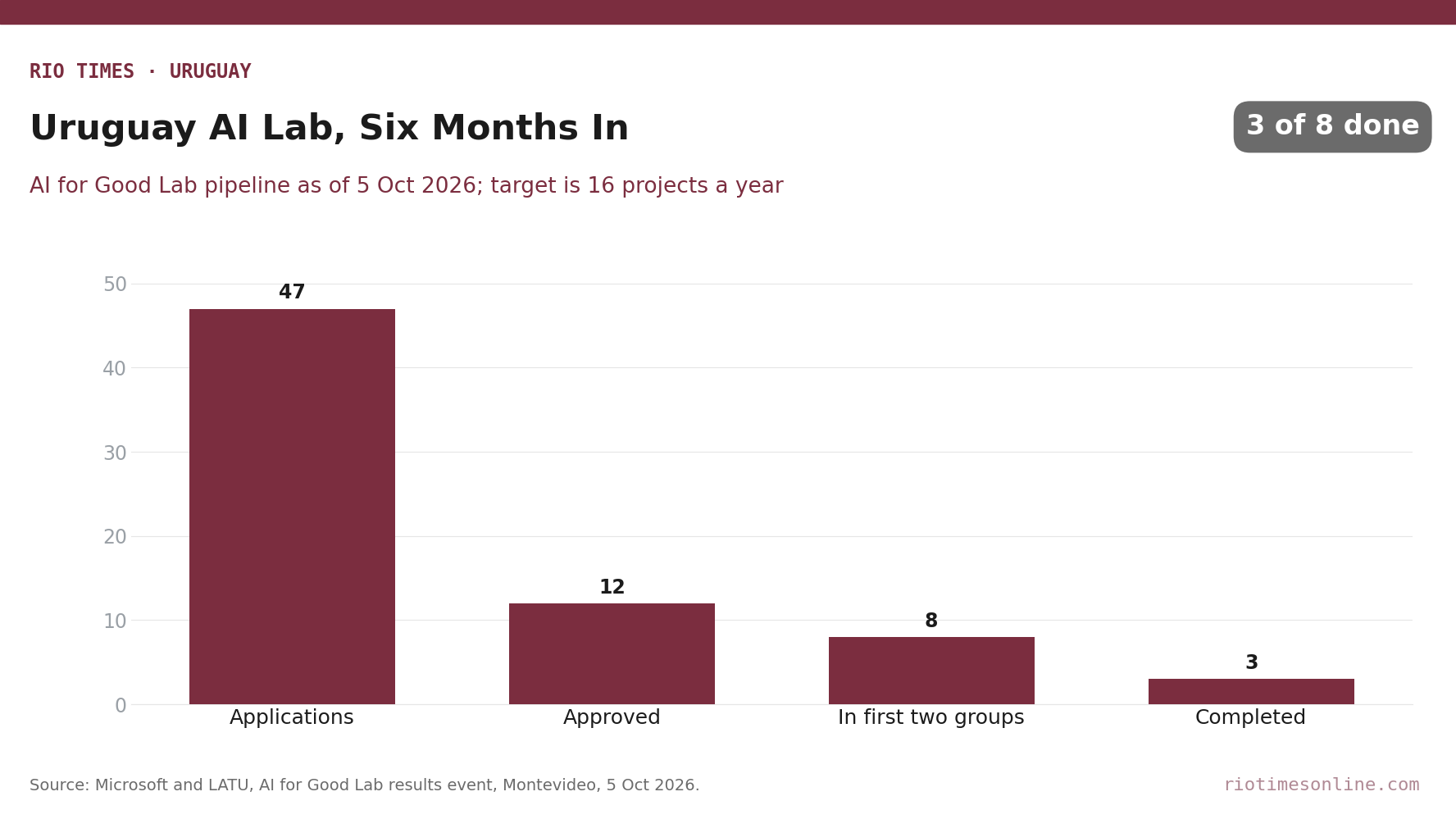
- —What happened The AI for Good Lab has built eight projects in its first two groups. Three are finished and five are due to finish in October.
- —The numbers 47 applications from 32 public bodies, 12 projects approved, 120 people trained and US$200,000 in cloud credits granted so far.
- —What it means for you Faster paperwork at registries and quicker state tenders are the promised gains. Firms dealing with Uruguay’s state would feel them first.
- —Still open Which three projects are finished, how many will go into everyday use, and what the tools cost to run after the lab.
Uruguay’s AI for Good Lab, run by the government with Microsoft, has built eight artificial intelligence projects for state bodies in its first six months. The partners presented the results on Monday 5 October at the Innovation Park of the Technological Laboratory of Uruguay (LATU) in Montevideo. For foreign readers, it shows a US tech giant helping a small, stable Latin American state automate its paperwork.
Three of the eight projects are finished and five are due to finish in October, Microsoft and LATU said. The tools cover tenders at the state power utility, document reading at the property registry and a chat assistant for the education technology agency.
LATU is the state-backed technology institute that leads the lab for the government. Its president, Lucila Arboleya, called the result an important message. “When we opened this laboratory, we set out to have 16 projects a year, and now, six months later, we have reached eight,” she told the Montevideo daily la diaria.
Eight Projects From Palm Pests to Tenders
Two of the projects are research work. The public Technological University of Uruguay (UTEC) uses drone images to spot palm trees that the red palm weevil, a destructive beetle, may attack next. A second project, run with LATU, reads satellite images to tell soy, sorghum and maize fields apart.
The other six target everyday state tasks, according to la diaria and the Buenos Aires business paper Ámbito:
- The General Registry Directorate of the Ministry of Education and Culture extracts data automatically from electronic documents to speed up filings.
- Ceibal, the state education technology programme, built a chat assistant for its internal wiki of more than 2,000 documents.
- UTE, the state power utility, is automating the drafting of its tender documents.
- The Hospital de Clínicas, a university hospital in Montevideo, is digitising handwritten records of kidney dialysis patients.
- The Tribunal de Cuentas, the state audit court, is getting a legal assistant to help draft reports.
- Agesic, the e-government agency under the presidency, is building an AI agent that helps people find the right online procedure.
Arboleya gave an example of why tenders matter. In some cases, she told Ámbito, two years can pass between a request for complex equipment and its arrival. “Any day you can cut from that process is extremely important,” she said.
Who Pays and Who Holds the Data
The lab is a partnership between Microsoft and the Uruguayan state. The industry ministry, LATU, the innovation agency Uruguay Innova, the state telecom company Antel, Agesic, the research agency ANII and the development agency ANDE all take part.
Arboleya told Ámbito the programme has about US$400,000 a year for three years, or about US$25,000 per project. Elianne Elbaum, who runs the lab for Microsoft in Uruguay, said the company matches every dollar Uruguay invests with credits for its Azure cloud. Microsoft’s own engineers build the tools with staff from each institution.
Responsibility for the data and for putting the tools to use stays with each institution. Arboleya told la diaria that each body signed a confidentiality agreement with Microsoft, so the data stays under the control of the Uruguayan state. She also said the first results show shorter processing times and fewer errors, without giving figures.
The push fits a wider plan. In New York on 22 September, at an AI dialogue hosted by the Inter-American Development Bank, President Yamandú Orsi of the centre-left Broad Front coalition pitched Uruguay as “a trusted regional hub” to develop, test and scale AI, his office said. For background on the country, see Uruguay Explained: The Country, Its Stability, Its Economy and What to Watch.
What It Means for You
For US investors, the lab is a small but visible public-sector showcase for Microsoft in Latin America. The sums are modest by the company’s standards, and the main gain is a foothold with state clients.
For companies that sell to Uruguay’s state or file papers with its registries, the promise is speed. Automated tender drafting at UTE and faster data extraction at the registry would cut waiting times, if the prototypes go into daily use.
For residents and expats, the Agesic agent aims to tell people which online procedure they need. The reports give no launch date. The broader economic picture is in Uruguay Has Room to Be More Ambitious, IMF Says.
What Is Not Known
Neither Microsoft nor LATU has said which three projects are finished. The partners also gave no figures for the time or money the tools save.
It is not clear how many prototypes will move into regular use, or who will pay for cloud computing after the lab’s credits end. Arboleya stressed that the institutions, not the lab, implement the pilots.
A third group starts in November with ANDE, ANII, Antel and the postal service Correos. Microsoft said four more projects will start in February 2027; la diaria reported March. The lab has not said how it will reach 16 projects in its first year.
Frequently Asked Questions
What is Uruguay’s AI for Good Lab?
It is a partnership between Microsoft and the Uruguayan government, launched on 11 March 2026 and led by the state technology institute LATU. It builds AI prototypes for public bodies in Montevideo.
How much does the lab cost?
LATU’s president said it has about US$400,000 a year for three years. Microsoft matches each dollar with credits for its Azure cloud service.
Who controls the data used by the projects?
According to LATU, each institution signed a confidentiality agreement with Microsoft, and the data remains under the control of the Uruguayan state.
Sources: Microsoft, results release, 5 October 2026; LATU, event notice; Ministry of Industry, Energy and Mining, launch release; la diaria; Ámbito; Presidency of Uruguay, Orsi at IDB AI dialogue, 22 September 2026.
This article was produced by The Rio Times’ automated newsroom system. How we use AI · Report an error · Editorial responsibility: Matthias Camenzind, Editor-in-Chief